Teaching Abroad Direct
More and more teachers working abroad are thinking of ways to save money given the increased cost of living on a global scale. According to 2026 figures from the Organisation for Economic Co-operation and Development (OECD), annual inflation increased to 4.6% in May 2026, up from 4.4% in April 2026. Inflation rose in 16 OECD countries, showing that price pressures remain widespread internationally. Energy inflation increased significantly, rising from 13.2% to 15.8% year-on-year across the OECD. Energy prices also rose in 26 out of 37 OECD countries with available data. Even though food inflation fell slightly to 3.6%, prices were still generally rising. Core inflation (which excludes food and energy and reflects broader price increases across the economy), rose from 3.6% to 3.8%.
With the financial pressure of inflation, frozen pay scales and the global rise in cost of living, teachers in countries worldwide are facing money worries and pressures on their salaries. This can lead many to think more about how much money they can save as a teacher living abroad, while also trying to cover basic monthly bills and other living costs.
The good news is, you can save money as a teacher working abroad, and this blog is going to explain how. Far from just being a gap year or a temporary career break, getting paid to teach abroad has evolved into a highly lucrative wealth-building strategy for many qualified teachers. By matching your skills with global demand, you can unlock a competitive salary with many included benefits that can really top up your bank balance.
That said, if your goal is to clear student debt, buy a property when returning to your home country or build an investment portfolio, you might want to be strategic in terms of the country you choose to teach in. The international teaching market is vast, and the percentage of wages you'll be able to put away will entirely depend on your destination. This guide will break down everything you need to know to save money as a teacher, from deciding where to teach based on salary and benefits, to lifestyle strategies that will help you put cash aside while living a life you love.
Teachers who are getting paid to teach abroad will often find that their compensation covers far more than just their main wage, with things like accommodation, health insurance and even return flights thrown in to make up a 'total package' of benefits. This package of benefits determines how much money you need to spend on things like rent, travel to your destination and utilities, and can have a major impact on how much spare cash you have to put aside.
That said, according to statistics from TEFL.org, accommodation and flights are either sometimes or not included if you're planning on teaching in regions like Europe. Southeast Asia can also be a mixed bag, with countries like Singapore, Laos, Thailand, Malaysia and Myanmar sometimes offering flights and accommodation, while countries like Cambodia, Indonesia and Vietnam usually expect teachers to source their own. By contrast, countries in central Asia (like Kazakhstan and Kyrgyzstan), provide accommodation as standard. Of course, specific schools regardless of region will have their own policies.
If you decide to make the move and get paid to teach abroad, depending on the country you choose, and as of 2025, figures suggest you can make up to $6,000 a month or £4,493. The best paid teaching jobs are typically in the Middle East and Asia. The UAE is one of the most popular destinations for teachers, with jobs in places like Dubai and Abu Dhabi offering earnings of roughly $3,500–$5,500/month. Destinations like South Korea and Japan pay $1,700–$4,000/month with housing and flight reimbursement often included, while China and Vietnam pay lower salaries but do have very low living costs that allow teachers to save around $1,000 a month if they do so carefully.
When trying to assess your full income potential as a teacher, it helps to plan ahead and figure out some key costs, such as your initial costs to get out there, whether you can secure a higher-paying job with certain qualifications, and determining whether the role you want to apply for has enough 'freebies' rolled in like accommodation and flights or healthcare.
There are several upfront costs that should be taken into consideration before you relocate. These often include documentation expenses such as passport applications or renewals, visa fees, work permits and any additional requirements like academic transcripts, background checks or medical records. Depending on the destination, these administrative costs can add up quickly and are typically the teacher’s responsibility.
You should also budget for travel and living expenses during the transition period. While some employers provide airfare, many teachers must pay for their own flights. It’s also important to have enough savings to cover 6-8 weeks of living costs before receiving your first monthly wage, along with an emergency fund for if you need to travel back home. Living costs should include things like food, local transport for getting around, mobile phone bills and everyday leisure activities you want to do on weekends.
One of the most effective ways to increase your earning potential is by developing specialised skills and expertise within your field. Employers offer higher wages and salaries to candidates who possess advanced certifications or experience in niche areas. Advanced qualifications can also open doors to more senior roles, greater responsibilities and opportunities in competitive markets where skilled professionals are in short supply. By investing in professional development and building expertise in a particular area, teachers can strengthen their value to employers and position themselves for better compensation throughout their careers. Teachers can explore available qualifications and professional development opportunities through education authorities, teaching unions, professional associations, universities and accredited training providers. Many employers and school districts also offer guidance on recommended certifications, specialist training and career progression pathways.
If you're looking to save money as a teacher, it may be worth exploring ESL teaching programmes. These programmes are typically run by language schools, educational institutions, government bodies or non-profit organisations, and are designed to place teachers in overseas roles while providing support throughout the relocation process. ESL programmes may offer free or subsidised housing, airfare reimbursement, medical insurance, visa support and paid holiday leave. Some even provide transportation allowances or housing stipends.
Here are some of the average monthly and annual salaries for teachers around the world in 2026, along with savings potential.
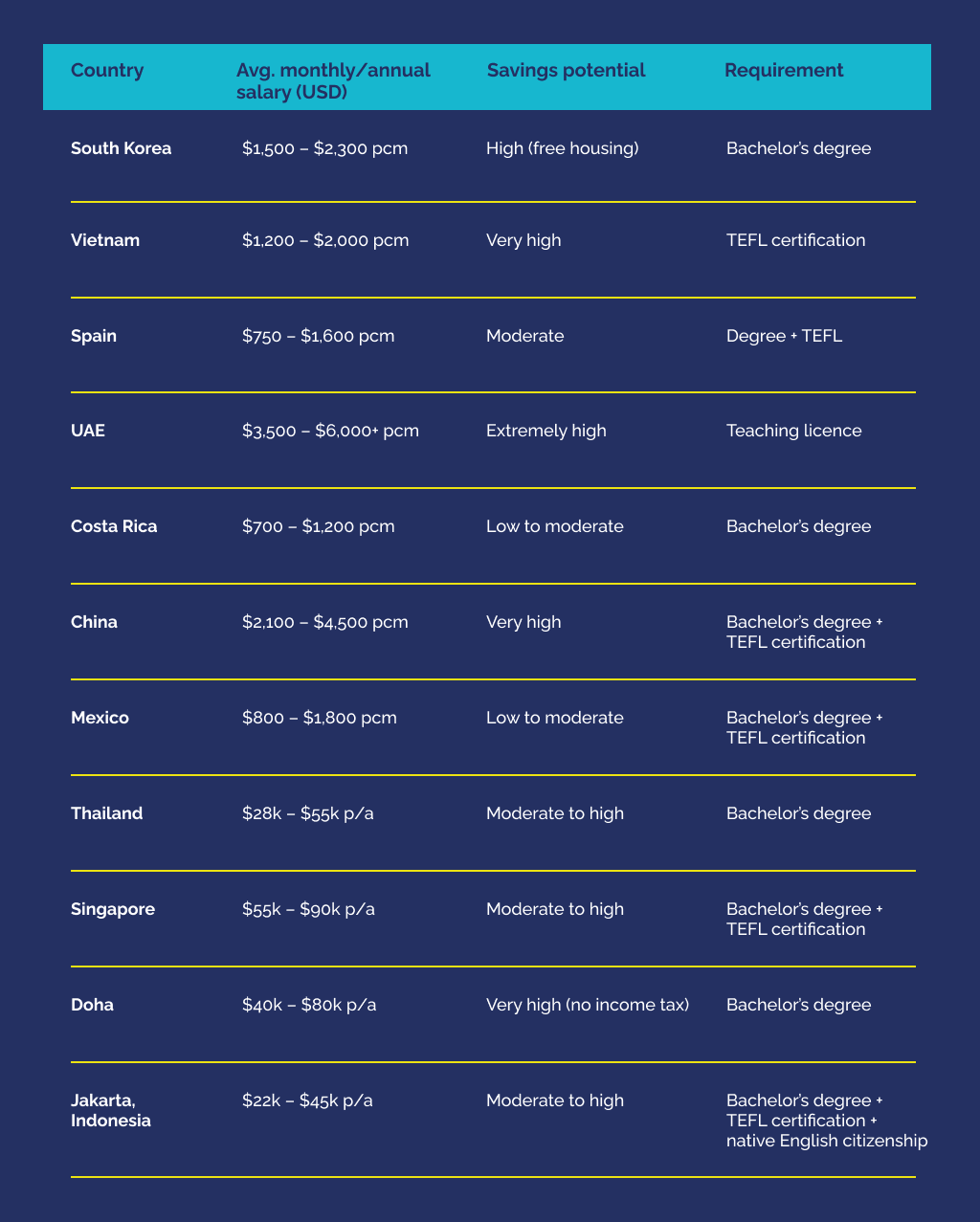
The United Arab Emirates (UAE) remains one of the most lucrative destinations for qualified teachers. Salaries at international schools (rather than public schools), can range from $3,500 to more than $6,000 per month, and because income is generally tax-free, teachers often take home significantly more than they would in comparable roles elsewhere. Many schools in places like Dubai also provide furnished accommodation or a housing allowance, annual return flights, comprehensive health insurance and end-of-contract bonuses. For experienced teachers, this combination of high salaries and low out-of-pocket expenses can create amazing potential for putting money aside. Choosing more affordable housing outside of prime rental areas or sharing rents with others to reduce utility costs can make your salary and savings go further, as well as using the Dubai Metro or local public bus systems over taxi rides or car leases.
For many teachers, destinations such as Vietnam, Thailand and Malaysia offer an ideal balance between earning enough to live well but spending far less on everyday essentials than they would back home.
Vietnam has become one of Southeast Asia's standout destinations for teachers looking to save the most money. Monthly salaries typically range from around $1,200 to $2,200, while living costs remain relatively low. Many teachers report saving between $500 and $1,000 per month, with some able to save as much as 60-80% of their income by embracing a local lifestyle. Affordable accommodation, inexpensive street food, low transport costs and strong demand for English teachers all contribute to Vietnam's reputation as one of the best-value teaching destinations.
Thailand is another popular destination for the same reasons. Although salaries are generally more modest (around $850 to $1,800 per month), day-to-day expenses are significantly lower than in many Western countries. Rent, local transport and dining out are inexpensive, meaning teachers can often save $200 to $500 per month while enjoying a relaxed lifestyle, tropical climate and easy access to travel. For many, the appeal lies less in accumulating wealth and more in achieving an excellent work-life balance without worrying about money.
Malaysia is another destination worth considering for teachers who want modern infrastructure without the high living costs found in countries like Singapore or Japan. The average English teacher salary is around 2,970 MYR ($700 USD), which is a modest salary, although international schools pay considerably more. Although wages may be lower, cities like Kuala Lumpur offer reliable public transport, affordable housing and very low prices for food and entertainment. Teachers can enjoy a comfortable standard of living while still putting money aside each month.
Have a savings-first approach to your pay as a teacher. Rather than saving whatever remains at the end of the month, decide how much you want to save as soon as your salary arrives and move that money immediately into a separate account (this could be to a bank back at home, for instance).
Many international teachers automate transfers to a savings account or send money home shortly after their payday. This habit reduces the temptation to overspend and ensures that saving becomes a priority rather than an afterthought. Even setting aside a fixed percentage of your earnings like 10 or 20% can result in significant savings over the course of your contract.
It can also be helpful to create a realistic monthly budget that accounts for rent, utilities, transport, food, travel and entertainment. Tracking your spending for the first few months abroad will give you a clearer understanding of where your money is going and where you can make adjustments.
One of the quickest ways to burn through your salary abroad is to fall into the 'expat bubble' and treat your teaching abroad as though it's a prolonged holiday. If you create a lifestyle that's focused around buying imported groceries you'd usually eat at home, international restaurants and social activities aimed primarily at foreign residents, the amount of spare cash you have left over will be greatly reduced. Of course, every teacher should feel free to treat themselves and enjoy these experiences occasionally, but having them too much will affect your savings pot and blitz through your salary quite quickly.
Teachers who embrace local life often find they experience a country's culture more authentically while spending considerably less. Shopping at local markets and supermarkets, eating regional cuisine, using neighbourhood services and exploring areas outside the main expatriate districts can really reduce monthly expenses. In many countries, locally produced goods and food are available at a fraction of the price of imported alternatives.
Adopting a local lifestyle doesn't mean giving up comfort – it means making more careful choices about where your money goes and recognising that some of the most rewarding experiences abroad are often the least expensive.
Many environmentally friendly habits happen to be excellent money-saving strategies. Small changes in your daily routine can lower both your environmental impact and your monthly expenses.
Choosing public transport, cycling or walking instead of relying on taxis and ride-sharing services can save hundreds of dollars over the course of a year. In many teaching destinations, public transportation networks are affordable, reliable and widely used by local residents.
Energy consumption is another area where costs can add up quickly. Air conditioning is often one of the largest household expenses in warmer climates. Using fans where possible, limiting unnecessary cooling and being mindful of electricity usage can help keep utility bills under control.
New arrivals can also save money by purchasing second-hand furniture, household items or bicycles from departing teachers and expatriates. Many teaching communities have online groups dedicated to buying and selling used items, allowing newcomers to furnish an apartment for a fraction of the cost of buying everything new.
Private tutoring is a great way to boost your earnings as a teacher abroad. Depending on the local market, private lessons can command significantly higher hourly rates than classroom teaching and provide an excellent way to fund travel, pay off student loans, or boost savings without relying solely on your primary salary. Private tutoring also receives high uptake, with enrolment rates above 70% in countries such as Singapore, Cambodia and Myanmar.
However, it's extremely important that you follow the legal rules of the country you travel to before accepting any private work, as there are many regulatory gaps within the private tutoring sector. Rules surrounding secondary employment vary considerably between countries, employers and visa types. In some destinations, private tutoring is common and may be permitted with employer approval or additional registration requirements. In others, it may violate the terms of your visa or employment contract.
Malaysia is a key example, as teachers working on employment passes are generally restricted to the employer named on their visa, meaning private tutoring or freelance teaching activities aren't legally permitted without specific authorisation. Violating visa conditions can result in fines, visa cancellation or future problems with immigration.
Before taking on any side work, review your employment contract carefully and consult local immigration regulations or your employer. While private tutoring can be a valuable source of additional income, protecting your legal status should always take priority.
At Teaching Abroad Direct, we help UK teachers secure positions in international schools right around the world.
Visit www.teachingabroaddirect.co.uk to learn more about teaching opportunities overseas.
Teaching Abroad Direct regularly speaks with British teachers currently working overseas.
Journalists interested in speaking with teachers currently working in other countries can contact us via [email protected]



