Teaching Abroad Direct
Abu Dhabi is the capital city of the United Arab Emirates (UAE), and is a popular destination for expats from countries around the world. It’s a modern city with many benefits that attract global professionals in a number of industries, including English teachers, software developers, and healthcare workers.
In this article, we will explore statistics about the expat population in Abu Dhabi, as well as what it’s like to live there, the cost of living, and the most common working industries.
There are approximately 2.2 million expatriates of more than 200 nationalities living in Abu Dhabi, according to the latest figures.
Abu Dhabi is the largest of the United Arab Emirates by population, with a total of 4,135,985, followed by Dubai with a population of 3,759,864.
Across the UAE, the vast majority of the population (88.5%) is made up of expats at a total of 10.04 million, with the Emirati population accounting for 11.5% (1.31 million) of the total population.
| Nationality | Population | Percentage |
|---|---|---|
| Emirati | 1.31 Million | 11.5% |
| Expat | 10.04 Million | 88.5% |
Throughout the UAE, the most common nationality among expats is Indian, making up 38.5% of the population, followed by Pakistani (16.7%) and Bangladeshi (7.4%).
| Nationality | Population | Percentage |
|---|---|---|
| India | 4.36 Million | 38.5% |
| Pakistan | 1.90 Million | 16.7% |
| Bangladesh | 0.84 Million | 7.4% |
| Philippines | 0.78 Million | 6.9% |
| Iran | 0.54 Million | 4.7% |
| Egypt | 0.48 Million | 4.2% |
| Nepal | 0.36 Million | 3.2% |
| Sri Lanka | 0.36 Million | 3.2% |
| China | 0.24 Million | 2.2% |
| All other countries | 0.19 Million | 1.7% |
Similar to working in Dubai, there are a number of benefits to working in Abu Dhabi, particularly as an expat from another country. Some of the key advantages include:
Abu Dhabi and London are two very different cities that vary when it comes to the cost of living. We’ve collected data on various costs like housing, transport, food, and utilities to create a comparison between the cost of living in Abu Dhabi and London.
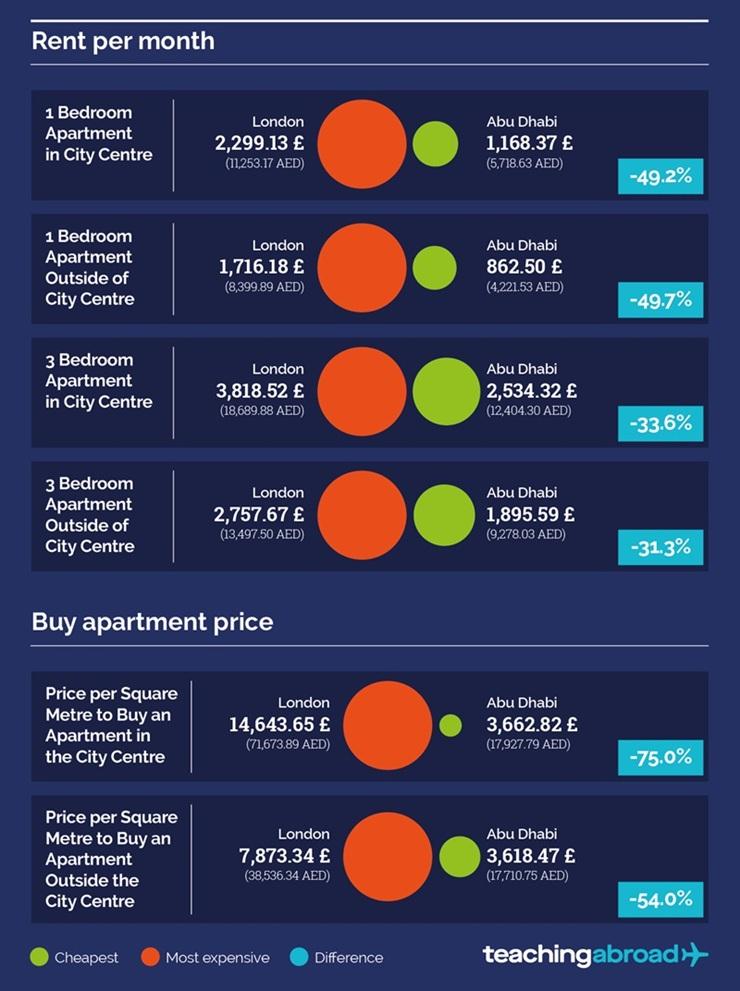
When looking at both renting and buying, housing costs in Abu Dhabi are significantly cheaper than in London across all apartment types. Renting a one-bedroom apartment in the city centre of Abu Dhabi costs 49% less than in London (£1,168 vs £2,299). If you’re looking to buy an apartment in the city centre, you can expect to pay 75% less in Abu Dhabi (£3,663 per square metre) compared to London (£14,644).
The costs for buying and renting all apartment sizes are at least 30% cheaper in Abu Dhabi than in London.
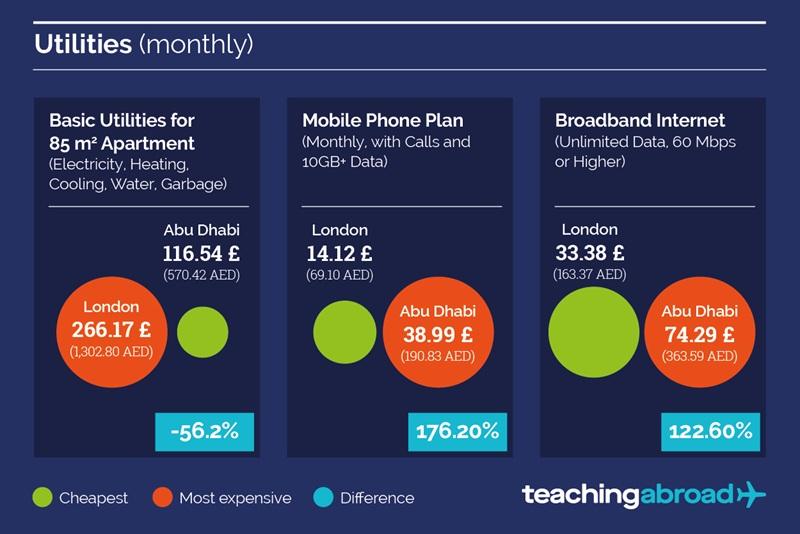
The cost of utilities gives a mixed picture between the two cities. Basic utilities like electricity, heating, and water for an 85m2 apartment are 56.2% cheaper in Abu Dhabi. However, internet and mobile phone plans cost considerably more in the UAE capital than in London. An average mobile phone plan with calls and 10GB of data costs £38.99 in Abu Dhabi, making it 176.2% more expensive than in London (£14.12), while broadband internet is 122.6% more costly.
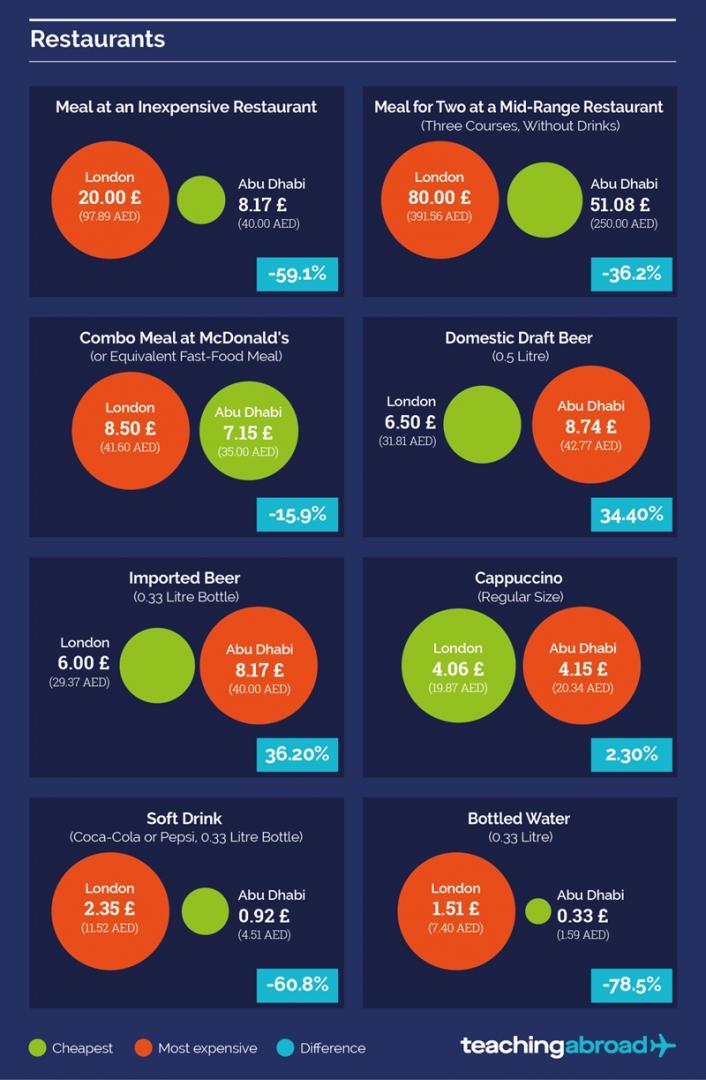
Data on the costs of eating and drinking at restaurants and bars shows that many of these things are considerably cheaper in Abu Dhabi than in London. The price of a meal at an inexpensive restaurant is typically only £8.17 in Abu Dhabi, making it 59.1% cheaper than in London, while a meal for two at a mid-range restaurant is 36.2% cheaper.
Some things, however, are more expensive in Abu Dhabi, specifically alcohol and coffee. A domestic draft beer costs 34.4% more in Abu Dhabi at £8.74 on average, compared to £6.50 in London. A regular cappuccino from a coffee shop costs only 2.3% more (£4.15 in Abu Dhabi vs £4.06 in London).
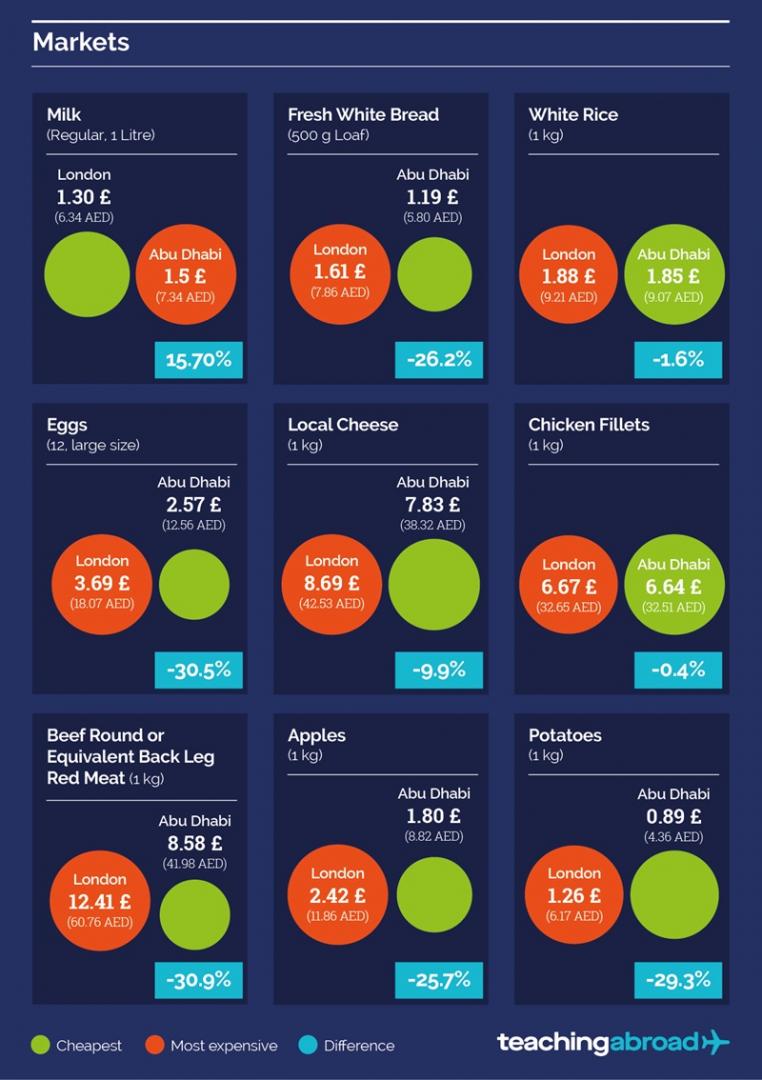
Grocery prices in Abu Dhabi are generally lower than in London, with some notable exceptions. Milk costs slightly more in Abu Dhabi at £1.50 per litre compared to £1.30 in London (15.7% more). However, most basic grocery items are cheaper in Abu Dhabi; fresh bread of 26.2% less expensive, eggs are 30.5% cheaper, and potatoes are 29.3% cheaper.
Other items like white rice, chicken fillets, and local cheese show minimal difference between the two cities, with prices within 1-10% of each other.
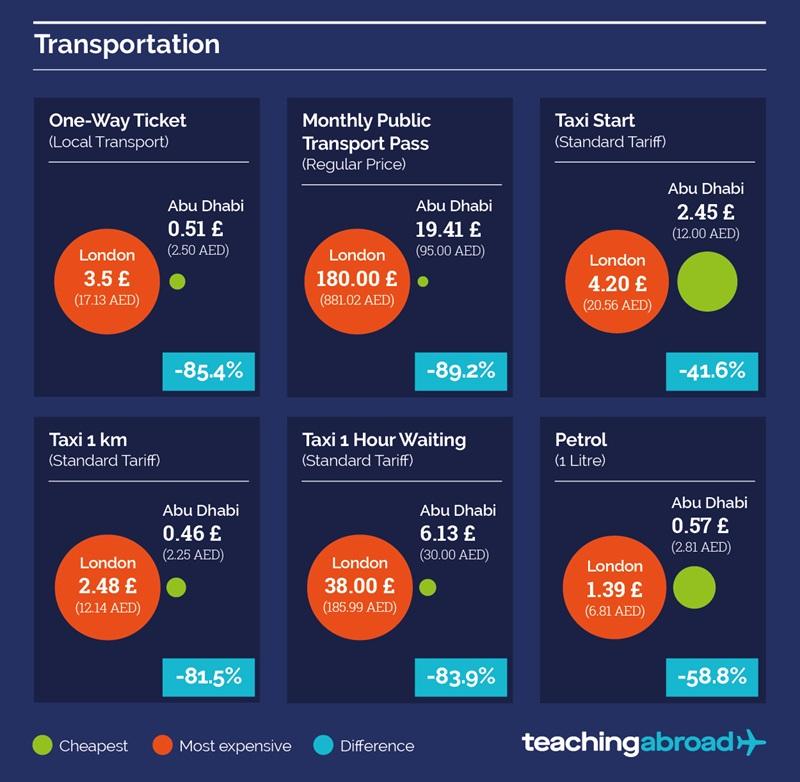
Perhaps the biggest difference between the cost of living in Abu Dhabi and London is in the cost of transportation. A number of transport options are more than 80% cheaper in Abu Dhabi, with monthly transport passes having the biggest difference (89.2% cheaper).
A one-way ticket using local transport costs an average of £0.51 in Abu Dhabi, where an equivalent ticket in London would cost you £3.50 (85.4% more). If you’re driving, one litre of petrol costs £0.57 in Abu Dhabi, while it’s 58.8% more in London at £1.39.
Though living costs are an important consideration, there are plenty of other quality-of-life factors to think about when it comes to living and working in Abu Dhabi. Overall, Abu Dhabi has a very high quality of life rating at 179.8, compared to London’s Moderate rating of 139.64.
Metrics | London | Abu Dhabi | ||
|---|---|---|---|---|
| Quality of Life Index | Moderate | 139.64 | Very High | 179.8 |
| Purchasing Power | Very High | 115.13 | Very High | 125.14 |
| Safety | Moderate | 44.49 | Very High | 88.96 |
| Health Care | High | 69.55 | High | 72.48 |
| Climate | Very High | 88.25 | Moderate | 43.89 |
| Cost of Living | High | 87.85 | Low | 55.41 |
| Property Price to Income Ratio | High | 15.99 | Low | 7.64 |
| Traffic Commute Time | High | 44.76 | Low | 30 |
| Pollution | Moderate | 58.11 | Moderate | 45.24 |
| Level of Crime | High | 64.99 | Very Low | 7 |
| Noise and Light Pollution | Moderate | 55.26 | Moderate | 46.37 |
Data note: Metric scores are based on Numbeo’s Quality of Life Indexes.
There are a number of sectors with in-demand job roles in Abu Dhabi, including healthcare, technology and education, with some specialist roles offering salaries of up to 65,000 AED per month (around £13,000).
In the Education and Training sector, STEM teachers, English language teachers and school principals are in high demand, with an estimated 200+ new schools planned for development in Abu Dhabi by 2030. International school programs in particular are seeking recruits in these professions.
| Sector | In-Demand Roles | Salary (AED/month) |
|---|---|---|
| Healthcare & Life Sciences | Doctors & specialists | 25,000–65,000 |
| Registered nurses | 8,000–18,000 | |
| Medical technologists | 12,000–25,000 | |
| AI, Tech & Cybersecurity | AI/ML engineers | 20,000–60,000 |
| Full-stack developers | 15,000–45,000 | |
| Cybersecurity specialists | 18,000–50,000 | |
| Education & Training | STEM teachers | 15,000–30,000 |
| English language teachers | 12,000–25,000 | |
| School principals | 25,000–45,000 | |
| Renewable Energy & Sustainability | Renewable energy engineers | 20,000–45,000 |
| Project managers (solar/wind) | 25,000–55,000 | |
| Environmental analysts | 15,000–35,000 | |
| Hospitality & Events | Hotel managers | 25,000–50,000 |
| Event coordinators | 18,000–40,000 | |
| Chefs & F&B managers | 12,000–35,000 |
There are plenty of reasons why Brits are choosing to live and work in Abu Dhabi, some of the top reasons include:
Abu Dhabi can provide a number of benefits for expats seeking financial incentives, career progression and improved quality of life. It combines lower costs of living with attractive employment packages and tax-free incomes, making it a desirable destination for anyone wanting to relocate. There are challenges, such as very high temperatures in summer, and higher costs for certain utilities like internet and phone plans, but its high quality of life ratings can outweigh these.



