Teaching Abroad Direct
In 2026, Dubai is a hugely popular destination for teachers from all over the world who want to teach a variety of subjects at international schools. This surge in popularity has been driven by a booming expatriate population and a large number of academic institutions offering jobs. Dubai is also a primary destination for teachers wanting a tax-free income, career opportunities and a luxurious lifestyle in a very safe part of the world.
As an English teacher, you have the power to shape and change the lives of students and the communities they're from. Being a teacher requires commitment to making a difference while encouraging and stimulating the minds of others for generations to come. If you're considering teaching English in Dubai, this blog will take you through some of the main reasons why this Emirate city is still a leading destination based on salary, career opportunities and quality of life.
According to the Knowledge and Human Development Authority (KHDA), Dubai is becoming a global destination for world-class higher education in particular, with a 21% rise in the number of academic programmes on offer. Around 198 international schools serve over 280,000 students from 182 different nationalities, making it a hugely diverse melting pot of people from different cultures and backgrounds. High standards, encouraging international collaboration and a wide variety of schools on offer (like private, international and public) has made Dubai one of cornerstones of high quality education.
The KHDA claims that over 17,000 international teachers are a part of Dubai's teaching community. This number continues to grow, with ongoing high demand. One of the most appealing aspects of teaching in Dubai is large number of teaching positions and career paths available. If you plan on living in Dubai as an English teacher, you'll find that there are many different paths you can take to diversify your career – whether you focus on higher education, early years or administration. These opportunities also extend beyond classroom work to opportunities developing curriculums, research or roles within educational boards and organisations.
This surge in growth and continued demand for English teachers (and other teachers generally) ties in with Dubai’s Education Strategy E33, which aims to establish at least 100 new private schools by 2033 and to improve the overall quality of education.
Aisha Miran, director general of KHDA, says: “Dubai continues to be an attractive destination for families seeking world-class education and for educators dedicated to shaping future generations. The growth in student enrolment, including Emirati students, alongside the expansion of new schools, reflects the strength of the city’s education ecosystem.”
“The E33 Strategy will continue to drive this sector forward by creating a diverse, inclusive environment where every student – regardless of background or ability – can access high-quality education and develop the skills they need to thrive in a globalised world.
“Our focus remains on fostering innovation, enhancing student wellbeing, and ensuring that education in Dubai empowers individuals to succeed and contribute to the ambitious goals set under the Dubai Economic Agenda D33 and the Dubai Social Agenda 33.”
One of the main draws to teaching jobs in Dubai is the tax free salary, which often makes affordability easier when compared to salaries paid in Western teaching roles.
In 2026, research indicates that teaching salaries in Dubai remain highly competitive, with an average monthly income of around AED 14,378 (approximately $3,900) across all education settings. Teachers working in language schools typically earn between AED 8,000–14,000 per month, while those in international schools can expect significantly higher packages, often ranging from AED 15,000 to 22,000+ depending on experience and role.
One of the biggest advantages is that income is completely tax-free, meaning take-home pay is substantially higher than in many Western countries. When combined with common benefits such as free or subsidised housing, annual return flights and comprehensive healthcare, the overall value of teaching packages is significantly enhanced. Even after living costs many teachers are still able to save between $1,000 and $3,000+ monthly, depending on lifestyle and school package.
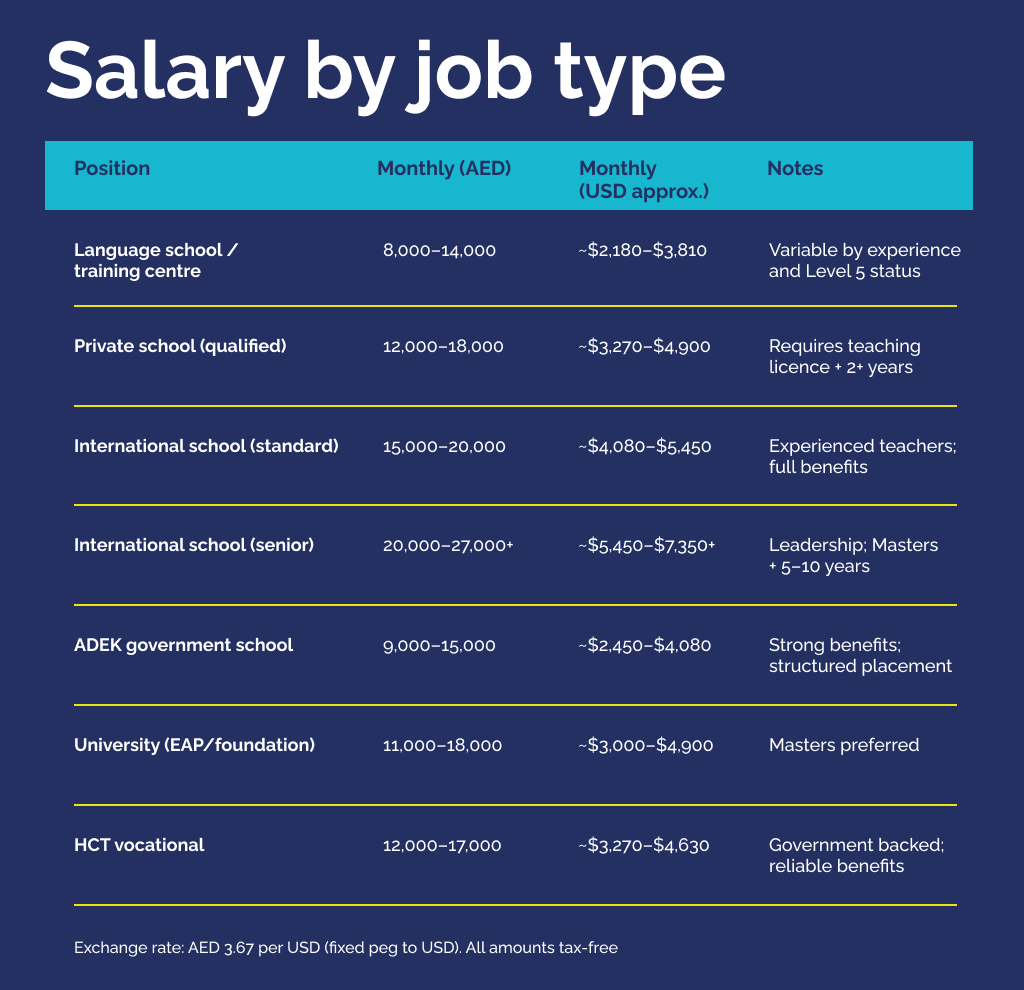
When comparing salary for English teaching jobs in Dubai, a good approach is to think about housing costs and how they are provided.
Salary alone doesn't reflect a compensation package's true value. In many international schools and ADEK-regulated government schools, teachers are provided with either a housing allowance or fully furnished accommodation as part of their contract. This significantly reduces one of the largest monthly living expenses for expats and makes overall packages far more attractive than the base salary might initially suggest. In contrast, language schools can vary more widely, with some offering limited or no housing support – this can make costs add up far more.
When housing is included or valued at approximately AED 6,000–10,000 per month, the effective value of a teaching package increases substantially. For example, a salary of around AED 14,000 per month can realistically equate to a total compensation value closer to AED 20,000–24,000 per month once accommodation benefits are taken into account. This is why Dubai is often considered one of the most financially rewarding international teaching destinations.
According to the TEFL Institute, as of March 2026, the Middle East TEFL market remains exceptionally strong, with continuous demand for English teachers across both government and private education sectors. In the UAE, programmes such as ADEK in Abu Dhabi and KHDA-regulated schools in Dubai continue to offer stable, long-term contracts, while wider investment in international education keeps recruitment levels high.
Across the region, Saudi Arabia’s Vision 2030 initiative is driving major expansion in English language education, particularly within universities and foundation programmes, resulting in increased hiring at scale.
Qatar continues to see steady demand for English instruction following ongoing post-infrastructure expansion, while Kuwait and Bahrain are actively recruiting to address teacher shortages in the wake of post-pandemic workforce changes. Oman maintains consistent year-round hiring within its college and higher education sector.
Dubai and Abu Dhabi continue to be the highest paying cities in terms of teacher salaries, offering some of the most competitive packages, with many international school roles paying between $3,200 and $5,900 per month tax-free.
Many teaching jobs in Dubai offer comprehensive benefits packages given by most schools. English teachers often receive housing allowances or fully furnished apartments, relocation assistance, annual airfare and comprehensive health insurance. Some schools even include bonuses, end-of-contract gratuities, or tuition support if you're bringing family. Reputable schools will assist with visa processing, on-boarding and local registration, and will even advise on everything from getting your banking set up, to phone plans.
Healthcare in Dubai is modern and to a good standard. This also means that it can be very expensive. Most schools provide comprehensive private medical insurance as part of their employment package, giving teachers access to excellent hospitals, clinics, and specialist services like physiotherapy when they need it. Having healthcare costs gives you peace of mind.
Many international schools include annual return flights to a teacher's home country, keeping them in touch with friends and family back home while ensuring that travel costs stay low and don't eat into their wage. Given Dubai's position as one of the world's leading aviation hubs, teachers can also take advantage of excellent flight connections to destinations across Europe, Asia and Africa.
Employees in the UAE are typically entitled to an end-of-service gratuity, which acts as a financial reward for completing a contract and remaining with an employer. Depending on salary level and length of service, this benefit can represent a substantial additional payment and is an important part of the overall compensation package offered by many schools.
English teachers relocating with their family may find that some schools offer discounted or fully subsidised school places for their children. Considering the cost of private education in Dubai, this benefit can provide significant savings and make an international teaching move more financially attractive for parents.
Almost all reputable international schools in Dubai provide full visa sponsorship as part of their employment package. They also have HR departments that organise help things like work permits, residency visas and medical processing. For teachers relocating from overseas, this significantly reduces the administrative burden and ensures a straightforward entry into the country.
Dubai is home to many world-class schools. Not-for-profit schools such as Dubai College and Jumeirah English Speaking School have built an excellent reputation since they were established 50 years ago, and remain hugely sought after today and among some of the most popular private schools globally.
New international schools are continuing to be built, with big budgets and purpose-built campuses. Many of these are owned by for-profit businesses, so they do operate more as commercial operations which cut costs and raise fees where they can. That aside, there are still plenty of good educational companies are based in Dubai. Private and international schools are the most common employers of foreign teachers, often delivering British, American, or IB curricula in English. IB training in particular is highly sought after within the international education sector.
Language schools primarily cater to Dubai’s large expatriate population, with a strong focus on English for business and everyday communication, while offering other languages such as German and Chinese.
English teachers are spoiled for choice with the range of opportunities available in Dubai. From ESL and private tutoring roles, to international exam board roles and broader education positions across schools and institutions – there are plenty of opportunities to grow a successful career. Because English is widely used as the main language within teaching, there are also opportunities for qualified teachers to move beyond English and teach subjects such as mathematics, science, technology and the arts. In some cases, private tutoring and specialist roles for high-profile families are also available through recruitment agencies.
There are often also clearer routes into leadership positions like head of department, key stage leader, curriculum coordinator, assistant principal, or principal – with career progression happening more quickly than other Western countries. Working within large international school groups can really quicken career development. Organisations such as GEMS Education, Nord Anglia Education, and Taaleem operate multiple schools across the UAE and internationally, creating opportunities for internal promotion, cross-campus collaboration and leadership development programmes.
Dubai is a modern city that has invested heavily in infrastructure, technology and public services, creating an environment where many everyday tasks can be completed quickly and efficiently. For international teachers relocating from abroad, this convenience can make the transition significantly smoother, allowing more time to focus on work, travel and enjoying life outside the classroom.
It has a digital-first approach to cumbersome paperwork like visa applications, residency renewals, utility payments and official documentation, all of which can be completed online through dedicated government platforms and mobile apps. Many banks offer mobile apps that make everyday financial management quick and convenient, and high-speed internet is widely available, supporting everything from online lesson planning and virtual classes, to staying connected with family and friends back home.
The city has also been designed to support a growing international population, with modern roads, efficient transport networks and reliable public services like the Dubai Metro helping people to get around easily.
Safety is another benefit, and Dubai is known for its well-maintained residential communities, low crime rates and secure neighbourhoods.
Living in Dubai as a teacher is means taking advantage of its lifestyle, with a mix of year-round warm weather, luxury facilities, leisure, culture and entertainment all on your doorstep. This culture allows teachers to enjoy their time outside the classroom.
With sunshine for most of the year, teachers can enjoy outdoor activities that may be limited by weather in cooler places like the UK. During the cooler months from October to April, residents can enjoy comfortable temperatures that are ideal for beach trips, outdoor dining, hiking and sightseeing. Evenings can be spent at rooftop restaurants, waterfront promenades and outdoor events that make the most of Dubai's favourable weather.
The city is also home to luxury resorts that offer day passes, beach clubs, spa facilities and weekend staycation opportunities. Destinations such as Palm Jumeirah, Bluewaters Island, and Dubai Marina provide a resort-style atmosphere that many teachers can enjoy throughout the year.
Beyond the coast, outdoor enthusiasts can explore the nearby desert through activities such as dune bashing, camel trekking, sandboarding and overnight desert camping. Nature lovers can also visit the Hatta region, which offers hiking trails, kayaking, mountain biking and incredible scenery.
Primary English lead at Deira International School, Claire Heylin, claims says she hasn’t looked back since flying to Dubai solo in 2015.
“Dubai is also much more than dazzling skyscrapers and city lights. My favourite activities include hiking through mountain wadis and trail running. I’ve been horse riding in the desert for sunset and recently attended a yoga class on top of the world’s tallest building, the Burj Khalifa. I would encourage all teachers contemplating a move to give it a go. Do not worry about coming alone – you will meet lots of people and make memories and opportunities to last a lifetime.”
If you want to gain experience teaching students from dozens of nationalities, a truly international teaching environment, diverse classrooms and exposure to different cultures, moving to Dubai for teaching would be the right choice for you. If you're also looking for a step up on your teaching CV, many teachers use Dubai as a stepping stone to leadership roles elsewhere in the international school sector.
Before applying for English teaching jobs in Dubai, ask yourself the following questions:
If the answer is 'yes' to most of these questions, Dubai could be an excellent destination for your next teaching role. With competitive salaries, strong career prospects, world-class schools, and an exceptional lifestyle, it's easy to see why Dubai remains one of the strongest destinations for English teachers in 2026.
Teaching Abroad Direct helps UK teachers secure English teaching positions in international schools around the world.
Visit www.teachingabroaddirect.co.uk to learn more about English teaching opportunities overseas and for teaching jobs in Dubai.
Teaching Abroad Direct regularly speaks with British teachers currently working overseas.
Journalists interested in speaking with teachers currently working in Dubai can contact us via [email protected]



