Teaching Abroad Direct
Are you thinking of how to become a teacher abroad? Maybe it's been a lifelong dream of yours, or perhaps you're just thinking of switching up the dreary skies of the UK and your normal 9-5 for a new adventure and the chance to experience a new culture? Trading your daily life in the UK for a classroom in Bangkok, Dubai or Madrid sounds like an absolute dream. And for thousands of teachers choosing international teaching jobs every year, it's exactly that. Choosing to teach abroad offers a rare combination of career growth, international travel and the chance to meet new people from a completely different country.
There are lots of things to think about when you're considering how to become a teacher abroad, and all before you've even hit that apply button. To prevent that initial excitement from quickly turning into overwhelming research, we've compiled a helpful guide to international teaching, covering common jobs topics such as:
Whether you're a newly qualified teacher looking for your first big gig, an experienced teacher looking for some international school vacancies or job experience, or a TEFL graduate planning a gap year, our guide to teaching abroad will get you in the know.
There are so many interesting countries to choose from when it comes to teaching abroad. From the sun-drenched beaches of Thailand, to the modern skylines of cities like Dubai in the UAE and the slower, more balanced pace of European countries like Spain.
Different destinations cater to vastly different personal goals and ways of living, so it's important to consider the type of lifestyle you want to live. It's likely that you'll be signing up to a contract that lasts for a year or potentially more if extended, so before you even crunch the numbers in terms of salary and living costs, ask yourself what kind of experience you want out of your time overseas. (This is actually a first step that's commonly overlooked by many teachers when they begin searching for jobs abroad). Remember there isn't a single 'best' country to teach in – the choice will be highly personal, and what works for each person will be different.
For instance, if your priority is aggressive tax-free savings, luxury living and modern city hubs (and you also don't mind a more conservative lifestyle, not to mention a considerably warmer climate), the UAE, Qatar or Saudi Arabia are fine choices. Opportunities in these countries offer some of the highest paying teaching jobs.
If you're looking for a more immersive cultural experience, with world-class food, vibrant local scenes and incredible weekend travel, Thailand, Vietnam or Malaysia may be right up your street.
If your main focus for teaching overseas is to advance your career with a stronger CV and more work experience (or to take the next rung up on the teaching ladder), destinations like China, Singapore and Hong Kong are good contenders. These locations are perfect for qualified teachers seeking higher level international school experience, fast career progression and highly paid packages.
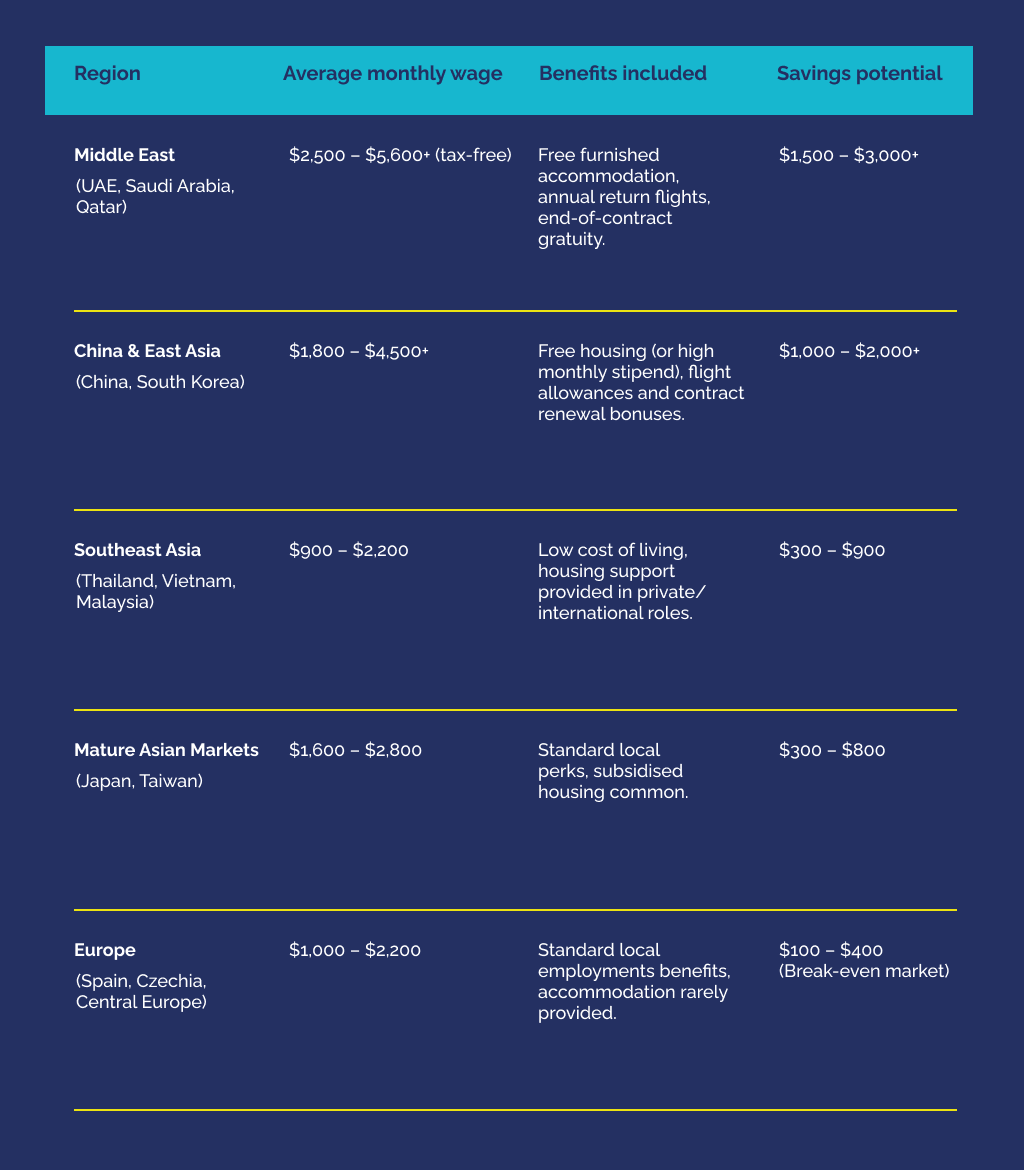
Main salary numbers alone can be deceiving, so when you're browsing international teaching jobs, keep in mind the benefits included. A top-tier monthly salary in an expensive market like Tokyo, Madrid or London might leave you with less spending money at the end of the month than a modest salary in Southeast Asia.
To determine where you can enjoy the best lifestyle and save the most money, you have to consider real disposable income. For instance, a $30,000 tax-free salary with free housing, health insurance and covered flights will almost always leave you richer than a $50,000 salary where you pay high local taxes and full market rent. Always evaluate the complete contract package offered to you. The following table breaks down salary, perks and and savings potentials per international market.
When browsing international teaching jobs, the curriculum a school follows determines far more than just what you’ll teach. Your workload, assessment style and whether you meet the hiring criteria will also be based on the role you choose. Tier-1 international schools generally follow one of three major frameworks: the British Curriculum (structured and exam-focused, typically requiring UK QTS), the International Baccalaureate (IB) (enquiry-based, student-led teaching), or the American Curriculum (flexible, continuous GPA grading and AP focus). Matching your prior experience to a school’s framework will help you adjust to your classroom and also improve your chances of application success.
Beyond international private schools, you may also encounter local government school systems or private language academies. Government programmes usually offer fixed, standardised state syllabuses with larger class sizes and lower administrative pressures, while language institutes focus primarily on conversational English skills and communicative teaching methods. Understanding these distinctions upfront helps you target schools where your teaching style, qualifications and workload preferences naturally fit best.
Before applying for teaching jobs abroad, you must make sure that your educational background and teaching credentials are the right fit for both local school expectations and national visa laws. The qualifications or certifications you'll need will vary greatly depending on whether you're aiming for a private language institute, a government public school, a prestigious international school, or a higher education institution like a university. While some regions in Latin America or informal language centres may offer flexibility regarding formal degrees, stricter markets in East Asia and the Gulf region tend to enforce degree and certification checks as part of their application and immigration process.
So, do you need a degree to teach abroad? The short answer is yes, if you want to meet the majority of requirements. A bachelor’s degree (in any discipline) is the standard minimum requirement for securing a legal work visa across Asia, the Middle East, Europe and North America. Subject-specific teachers (such as STEM or economics teachers), and university lecturers typically require a degree directly related to their field, with higher education roles usually demanding at least a master’s degree or PhD. If you apply without a degree, you'll likely need to demonstrate considerable and more senior teaching experience.
If you're aiming to apply for roles tier-1 international schools, a full teaching licence from your home country such as UK Qualified Teacher Status (QTS), a PGCE, or state teaching certification is essential. For English language instruction in private academies or public school schemes, a recognised 120-hour accredited teaching certificate or CELTA is usually the benchmark.
While demand for English teachers is generally high across many countries, there's immense global demand for teachers who are qualified in specialist subjects like physics, chemistry, biology, information technology, mathematics, business, economics and physical education (PE). The UNESCO Institute for Statistics claimed in 2016 that the world would need almost 69 million new teachers to reach 2030 education goals.
It's also worth mentioning that certifications obtained via distance or online learning portals and programmes can either be subjected to extra scrutiny or refused altogether. For instance, as of 2019, Qatar’s Ministry of Foreign Affairs doesn't accept distance learning or online qualification certificates if a teacher is applying for a working visa. Some people have reported a workaround if 'distance learning' or the phrase 'online' aren't mentioned anywhere on the paperwork itself. Another example is Abu Dhabi in the UAE, where primary teachers must have a Bachelor of Education, not a primary PGCE.
Regardless of the subject you'll teach or the school you've applied to, there will always be a certain level of bureaucracy when it comes to visa applications. The best advice we can offer is to stay calm and patient. The visa application process will differ slightly from country to country, but you should start gathering your paperwork early. Document processing and background checks can take anywhere from 4 to 12 weeks. Top international schools typically begin visa paperwork 3 to 6 months prior to the August or January term start dates.
Most countries will want you to apply for an employment visa in order to teach abroad. Before you do, your employer (e.g., international school, university department or government education ministry) must issue a formal invitation letter or local work permit approval. Many schools will handle the paperwork on their end and guide you through the embassy application in your home country, so it's always worth checking with the school itself and get them to outline the typical process.
Immigration authorities in regions like East Asia, the Middle East and Europe strictly access academic transcripts and degree certifications. If your role is specialist, like a high school physics teacher or an economics lecturer, your degree must usually match your teaching subject. For general education and teaching English as a foreign language, many schools will require a bachelor’s degree. Degree certificates, other certifications and background checks must also be authenticated to prove they are genuine.
A legal teaching visa usually requires a clean, official criminal record check issued within 3 to 6 months of the application.
When applying for international teaching jobs, your CV needs to be your biggest 'sell'. It needs to show you're the ideal candidate out of thousands of applicants. (Remember that international schools have busy hiring teams reviewing applications from all over the world).
Keep your layout clear, easy to skim through and scan (recruiters rarely read every page in detail), and use no more than 3 pages. State your full name, contact details like email, nationality and dependent status right at the top. These details will directly impact visa options and school-provided housing benefits.
Rather than simply listing past job duties, focus on how you can provide evidence for your teaching experience. List before and after cases, student achievements, instances of classroom leadership and your experience with global frameworks like the IB, British or American curricula. International schools love candidates who can demonstrate strong adaptability, cultural awareness and work under pressure, so if you can give clear examples of this, you'll stand a greater chance. You should also demonstrate a clear commitment to student safeguarding standards.
Rather than sending generic templates, you'll have a much better chance of securing an interview if you tailor each application to the specific school and job you're applying for. Include a focused cover letter that highlights your unique teaching approach and what you can offer that particular school. Many international schools also use Automated Applicant Tracking Systems (ATS). So if you naturally include keywords from the job description like 'classroom management' or 'inclusive education', that'll help your CV to get through those frustrating initial screening filters. For more information on crafting that perfect teaching abroad resume and more examples, read our blog post on how to write a standout CV for international teaching jobs.
Working with a dedicated international teaching agency like Teaching Abroad Direct is the best way to be connected directly with vetted international schools that match your experience, curriculum preferences, location, salary expectations and lifestyle goals. You can browse our teaching jobs for more information and to filter open vacancies by international region and subject specialism.
If you prefer to lead your own search, use curated, industry-specific job boards rather than general recruitment platforms. Be aware of scam and illegitimate adverts. For instance, reputable international schools will never offer you a job based solely on an emailed CV without conducting at least one thorough video interview. Schools asking you to wire money via personal bank transfer for things like 'visa processing' is another major red flag. Always insist on a written and formal contract that dictates the hours you'll teach, salary, any housing allowance and extras like flights, healthcare, childcare etc. before signing anything.
The next step is usually a virtual interview (using video software like Google Meet, Zoom or Teams). Beyond the claims on your CV, hiring teams want to see a positive and adaptable mindset, a commitment to professional development and advancing your career, confidence in your abilities and great communication skills.
When answering common questions about your teaching philosophy, strengths, or motivations avoid vague phrases or using buzzwords. Instead, give concrete examples of how your classroom operates in practice. It could be a before and after scenario for instance, such as how your teaching methods and approach changed a classroom's grades for the better.
Rather than simply saying you prefer learning that puts the student at the heart of it, explain how student-focused learning is implemented in your classroom. This could be through things like pair work, enquiry-based projects, or giving students a real-world problem to solve in teams.
Being self-aware is another positive. Don't be afraid to discuss areas you want to improve in your teaching methods. Reflective teachers who actively seek out ways they can learn different techniques and try new strategies are highly valued by international schools.
While living abroad is a major perk, frame your answers around your passion as a teacher rather than referencing your love of travel or tourism. No-one wants to interview someone who just wants to focus on the travel perks.
Some international schools ask for a short recorded micro-lesson or a live 10-minute teaching demo during your interview. While teaching a 'mock' class may seem unusual, here's how to get through it.
After the interview, send the interviewer an email thanking them for their time and reminding them of your interest in the position. This is seen as polite while giving an impression of genuine interest.
You've got the offer of your dreams! Next, it's time to review your contract and the small print. Alongside your salary, check for other perks that are rolled into your package, such as health insurance, flights to and from home, housing/rent and training. For some teachers for instance, their rent is covered by their employer, which can add considerable value to the amount of money they can save up. If there's a particular benefit you'd like to have included, this is a good opportunity to try and negotiate for it. You can check out our teacher salary index to help you determine teaching salaries versus costs of living.
You leave in six months – it's time to get organised! Grab yourself a calendar and planner so you can create a checklist of everything you need to sort out before your travels. Before your move to teach abroad, get the following in order:
At Teaching Abroad Direct, we help UK teachers secure positions in international schools right around the globe.
Visit www.teachingabroaddirect.co.uk to learn more about teaching opportunities overseas.
Teaching Abroad Direct regularly speaks with British teachers currently working overseas.
Journalists interested in speaking with teachers currently working in other countries can contact us via [email protected]



