Teaching Abroad Direct
Living in Saudi Arabia as an expat might not be the first destination that pops into your head if you're considering working abroad as a teacher. For a long time, Saudi Arabia's reputation as a highly conservative society, combined with general misconceptions about safety in the Middle East, made many Western teachers hesitate. The truth is, if you look beyond the old stereotypes, you’ll find one of the most exciting, rewarding and rapidly transforming countries in the world.
Saudi Arabia is a conservative Islamic society with many more restrictions than western countries. Teachers who are open minded and embracing of gender-segregated public spaces, strict dress codes in public, no alcohol and a cultural context that is significantly different from the West will thrive. Teachers who prepare culturally, do thorough research and commit to the experience will find the experience of teaching in Saudi Arabia both personally and professionally rewarding. Those who don't make these preparations may struggle to adjust.
If you've been wondering what living in Saudi Arabia is actually like for teachers who relocate there, this blog will take you through some of the main statistics, including details on salaries, costs of living and expat life.
Contrary to popular belief, Saudi Arabia boasts an incredibly low crime rate – significantly lower than many major Western cities. Expats are highly respected and well looked after. While public social rules are different to back home, communities are tight-knit, welcoming and remarkably secure. Teaching here isn't just a job, but an opportunity for personal growth and to experience a completely different Arabic culture. You'll also be helping local citizens to gain access to global career opportunities by teaching them English and other subjects. In return, you get to immerse yourself in the birthplace of Arab culture.
Generous financial packages are on offer, too. Generally teachers' wages are in the range of $3,000 – $4,000 per month in a lower level language school, but university-level teaching positions can be significantly more than this. English-speaking teachers are in incredibly high demand currently, so there is wiggle room to negotiate higher salaries for certain positions. Because the local demand for high-quality education far outweighs supply, schools offer highly competitive, tax-free salaries alongside great benefits packages to attract the best talent. No surprise then that teaching in Saudi Arabia is a great idea if your financial plan is to build up your savings.
All of this aside, Saudi Arabia has high expectations of its teachers, and you'll need to display prior classroom experience and credentials such as a TEFL certification or a degree in the subject you intend to teach. Getting a teaching job in Saudi Arabia with no degree is possible, but you’ll likely be expected to possess extensive experience to compensate for this. 30% of teachers have non-teaching work experience.
These premium schools follow Western curricula such as British, American or IB and recruit both primary homeroom teachers and secondary subject specialists. Initial contracts are 1 to 2 years and offer the best overall benefit packages.
Distinct from international schools, these institutions teach the Saudi national curriculum but place a heavy, bilingual emphasis on English, mathematics and science. The academic calendar mirrors Western schedules, running from August to June. Teachers can expect an immersive experience with local students.
Typically the highest-paying educational opportunities in the country. These positions generally require a Master’s degree and focus on teaching academic English in Preparatory Year Programmes (PYPs). They offer fantastic working hours and extensive paid university holidays.
This route is ideal for those with a Bachelor's degree and a TEFL certificate. These positions focus purely on language acquisition for adults and business professionals, meaning hours often shift to evenings and weekends.
For licenced, Western-certified teachers (those holding a PGCE or state teaching licence), Tier-1 International Schools in Riyadh and Jeddah are the most preferred roles. For teachers whose background is strictly in English language instruction (holding a Master's in TESOL or Applied Linguistics), University Prep Programmes are overwhelmingly preferred over private language academies.
Under Saudi Arabia's Vision 2030 initiative spearheaded by Crown Prince Mohammed bin Salman, the country is undergoing one of the fastest, most ambitious national transformations in modern history. It's starting the move away from oil dependency to focus on a knowledge-based global economy that tempts professionals from various industries all over the world. Alongside sweeping social reforms like improving women's empowerment and building a vibrant entertainment and cultural scene, the Saudi government is also pouring billions into education to make it a world-class leader in this sector.
To do this, a new curriculum has been rolled out that's more interactive, student-focused and concentrated on critical thinking, creativity and real life issues to prepare students for a modern, international workplace. The latest research centres are being built with new technologies, with classrooms being outfitted with the latest digital learning platforms, state-of-the-art facilities and advanced educational tools. 42% of teachers in Saudi Arabia work in schools where at least one hybrid or online lesson was taught in the last month (higher than the OECD average of 16%), while 43% of teachers report using artificial intelligence (AI) in their work at some point (higher than the OECD average of 36%).
According to UNESCO's 2026 GEM report, the Saudi government routinely allocates roughly 17% of its total annual public expenditure straight to education. In recent budget cycles, this has translated to over $50 Billion USD (SAR 189 Billion) in a single year, far outpacing the education spend of many Western and OECD nations. The number of students enrolled in private educational institutions has also exploded fivefold in just fifteen years, skyrocketing from 20,000 in 2007 up to 104,000.
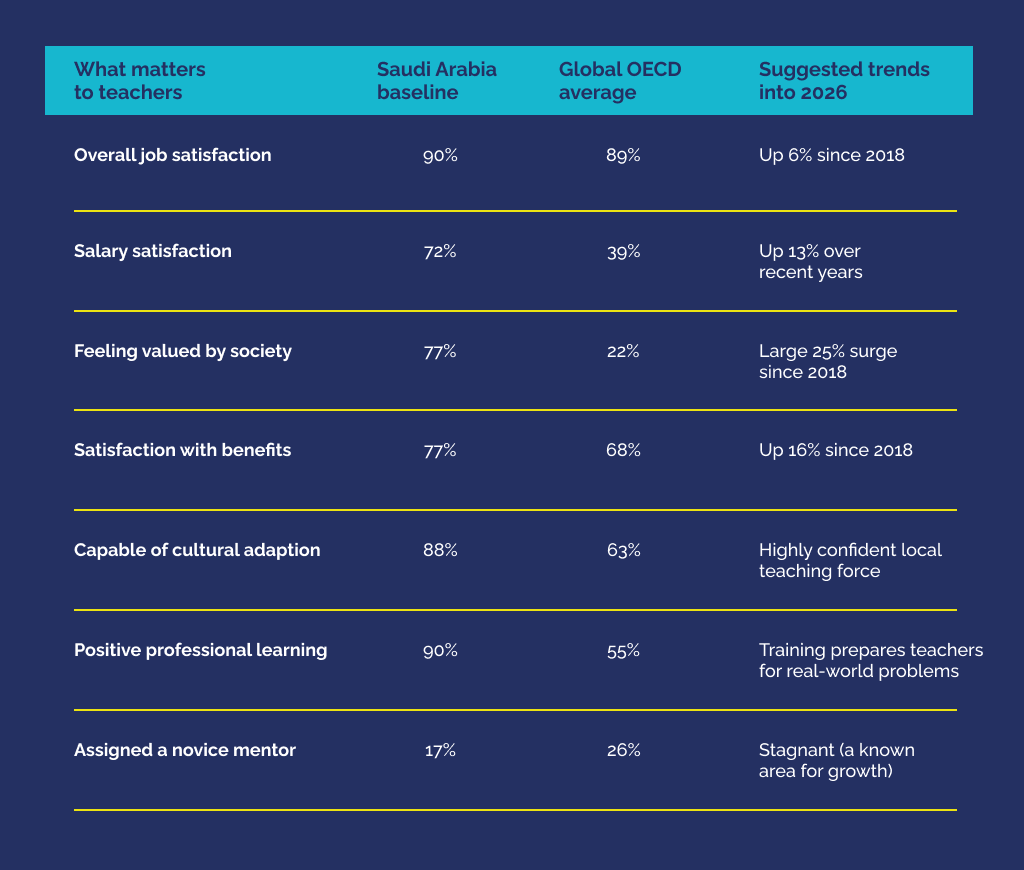
So how do teachers in Saudi Arabia really feel about their jobs? According to global data from the OECD TALIS Survey in 2024, Saudi Arabia boasts some of the highest teacher satisfaction and societal respect metrics in the world, but teaching as a role does come with its own unique set of workplace pressures.
A particularly notable statistic is that 77% of teachers in Saudi Arabia feel deeply valued by society. This is a figure that has soared by 25% since 2018, completely overtaking the global OECD average of just 22%. This respect translates directly into overall happiness, with 94% of teachers reporting overall job satisfaction.
Why are teachers so satisfied? The numbers point directly to terms of employment and better compensation. 72% of teachers in Saudi Arabia are highly satisfied with their salaries (compared to a global average of just 39%), and 77% are thrilled with their broader contract benefits, like housing and healthcare allowances.
Saudi Arabia features a relatively young teaching workforce, with an average age of 43. However, the workforce is maturing rapidly. The share of veteran teachers aged 50 and above has risen by 12 percentage points since 2018
Teaching in Saudi Arabia rarely means navigating highly chaotic or linguistically divided classrooms. Only 4% of teachers operate in classrooms where more than 10% of the students speak a different first language than the language of instruction. Saudi students are highly receptive to holistic education, with 90% of teachers feeling completely equipped to support their students' social and emotional learning (well above the 73% global average).
Saudi schools are rigorous environments. When asked about stress, teachers pointed to three major problems – heavy lesson loads (63%), high pressure regarding student achievement scores (62%) and large volumes of marking/grading (62%).
To navigate these pressures, teachers rely on teamwork and helping each other. The most common team activities include analysing specific student development (33%), balancing common grading and evaluation standards (27%) and engaging in shared professional learning groups (21%).
“Choosing to leave my job as a primary school teacher in the UK and teach in a British International School at a military base, somewhere in the desert near Kuwait and Iraq, was not a decision I took lightly,” says Margie Tidjani who took the leap and followed her dream to teach abroad in Saudi Arabia, despite being 'a desperately shy person'.
Recalling her experience, she says: “Gone were the long, overworked, highly charged and stressful days of before. Our days begin at 7.15 am and end at 2pm. We’re expected to stay until 2.45 pm to mark books and organise the classroom. I soon found that on most days I would be home by 3 pm. The rest of the day was then mine!”
“Time is a commodity not available to most professionals working in the UK. Here in Saudi I have plenty of it. I’ve been able to make regular use of the ladies-only gym and swimming pool. I would try to keep gainfully occupied by reading, learning Arabic and Qur’an and praying on time, a luxury I had not had in the UK.”
According to The Wondering Staffroom, lower to mid-range schools in Saudi Arabia advertise salaries in the range of 7,000–10,000 SAR (£1,393 to £1,991) per month for classroom teachers, often with accommodation provided and annual flights. Within established international schools, teachers report salaries of between 10,000–17,000 SAR (£1,990.92 – £3,384.56) per month range, tax-free, with housing, flights, medical insurance and sometimes school places for dependants rolled in. Leadership roles and specialist posts may sit above this band.
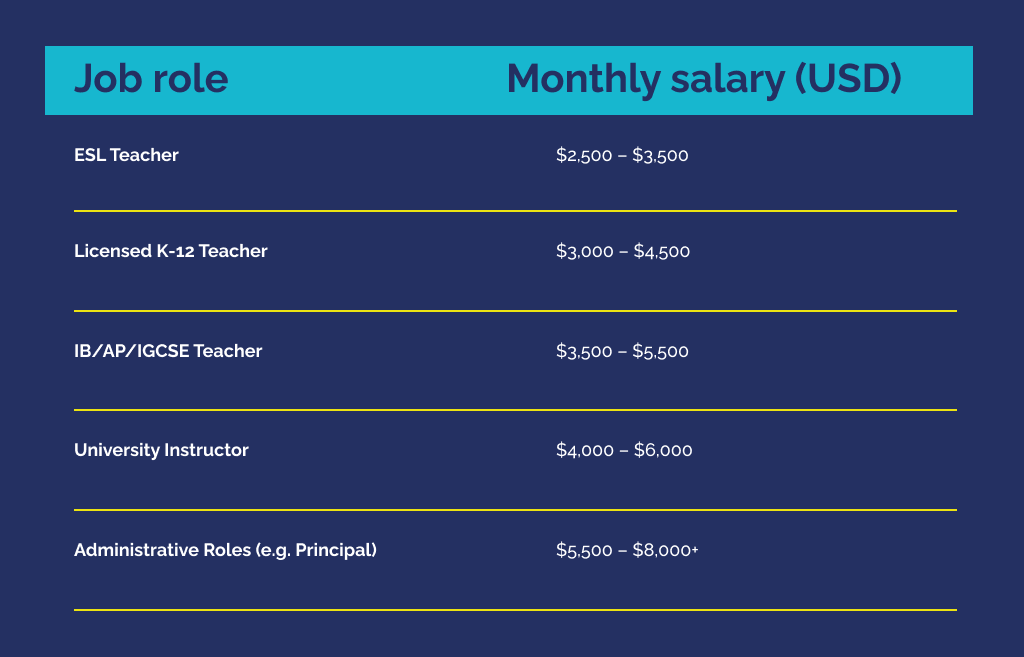
Source: Teachingnomad.com
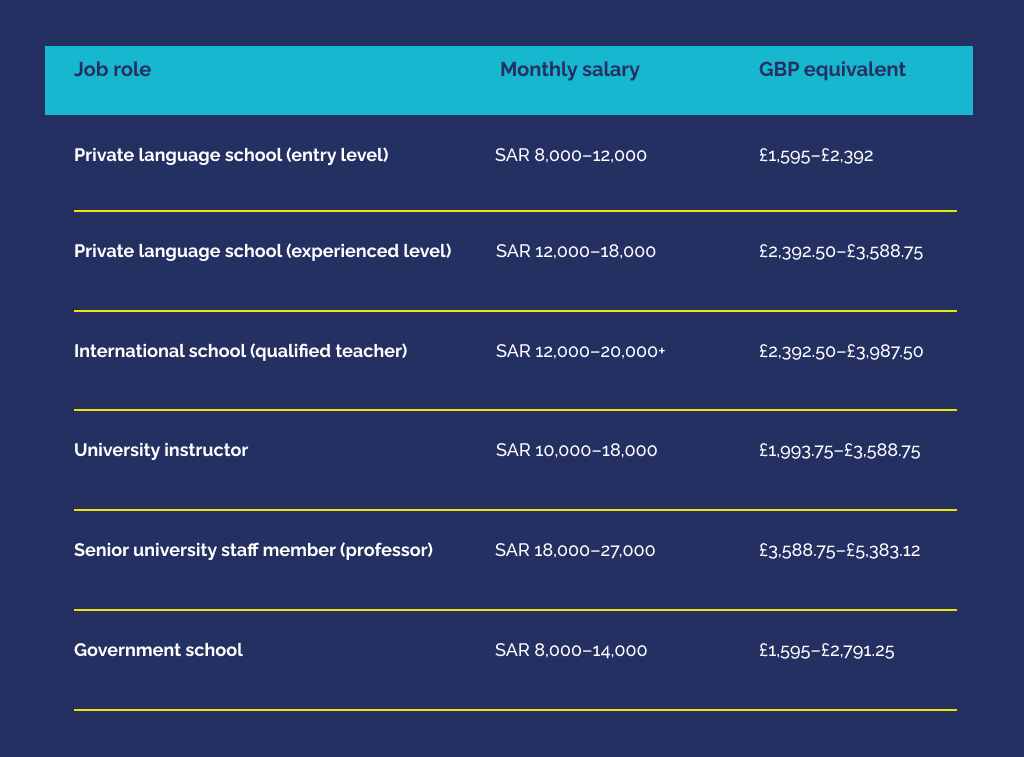
Source: TEFLheaven.com
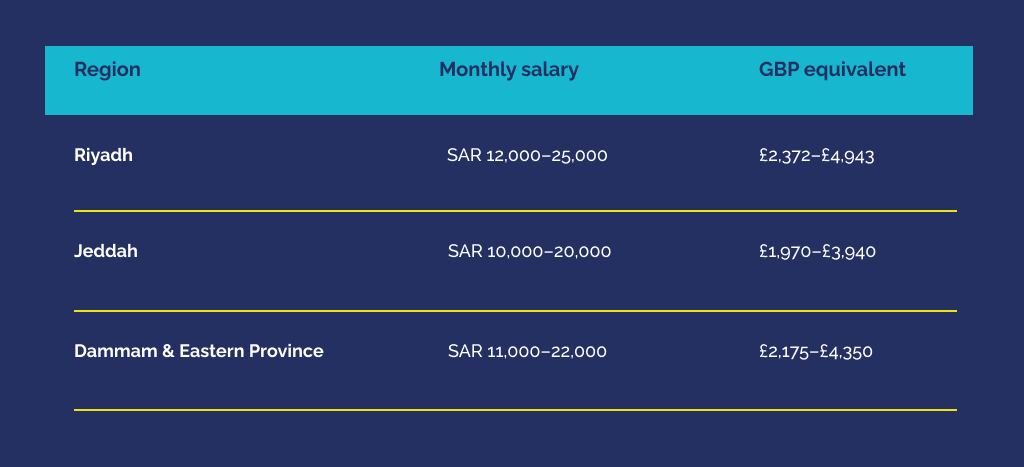
Sources: The TEFL Org, Teaching Nomad, GoOverseas
One of the reasons so many teachers choose to live and work in Saudi Arabia as an expat is because the base salary they receive is only half the picture when it comes to benefits. Saudi Arabia is widely considered one of the most lucrative expat teaching destinations due to the comprehensive cost-of-living benefits that are built directly into standard school contracts. Because your employer absorbs almost all of your major expenses, your tax-free salary functions almost entirely as disposable income or pure savings. Most reputable international schools, universities and language academies offer a benefits package that includes:
The single largest monthly expense for most people (i.e. rent) is completely covered. Schools typically provide high-quality, fully furnished apartments (often in secure expat compounds with pools and gyms) or offer a generous monthly stipend for teachers to choose a place of their own.
If you want to head back to see family and friends once a year, your contract will generally include a paid, round-trip flight during the long summer break, so there's no need to dip into your savings pot.
Most teachers also receive premium private health and dental coverage, ensuring you have hassle-free access to modern medical facilities if required.
Known locally as the "End of Service" benefit, this is a legally mandated cash bonus paid out when a teacher's contract ends, typically calculated as a half-month to full-month's salary for every year of service you’ve completed.
With the education sector rapidly modernising, schools heavily invest in their staff, frequently sponsoring accredited workshops, IB training, or training for teachers to progress in their careers.
There can be a certain level of bureaucracy in getting the right paperwork. Your school takes care of the entire residency permit (Iqama) process, covering all government fees and guiding you step-by-step through the visa sponsorship.
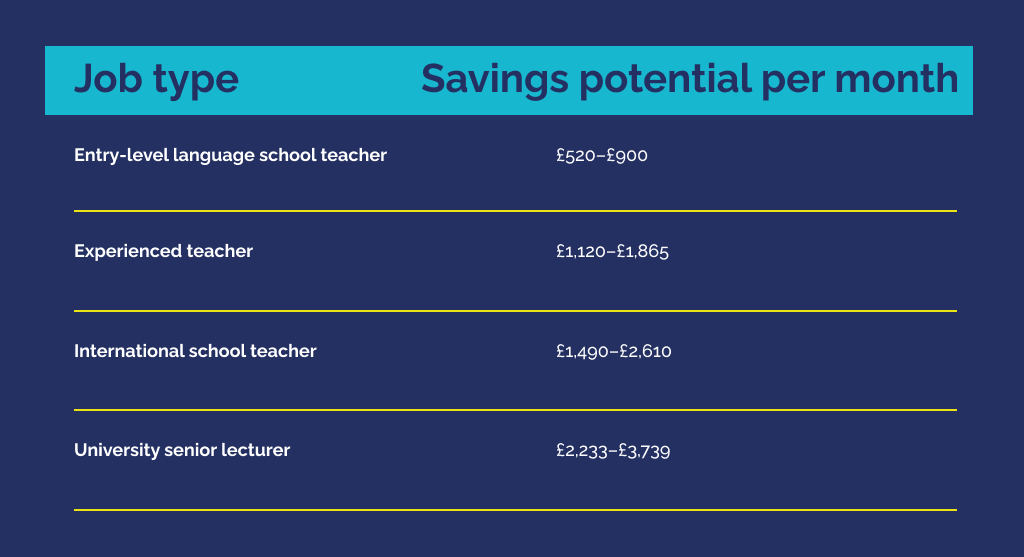
It's important to note that the amount a teacher can save depends on their own personal spending habits and the extent to which their employer has other benefits rolled into their contract. Alcohol isn't available in Saudi Arabia, and entertainment options are more limited than back in the UK. Some teachers find that for these reasons there is less temptation to overspend. The table below shows savings potential by teaching role.
According to numbeo.com, the estimated monthly costs for a family of four are £2,117 (10,658 SAR), excluding rent.
The estimated monthly costs for a single person are £579 (2,918 SAR), excluding rent.
On average, the cost of living in Saudi Arabia is, on average, 33.8% lower than in the United Kingdom.
While major metropolitan hubs like Riyadh and Jeddah have seen a steady rise in lifestyle costs due to rapid economic expansion and a thriving expat population, many everyday necessities remain highly affordable in Saudi Arabia when compared to other western countries. Domestic energy, water and local food goods are heavily supported, making the baseline cost of maintaining a home more manageable. However, imported brand-name foods, luxury shopping, dining out at mid-to-high-end restaurants and private health insurance can quickly increase a monthly budget if not planned for carefully.
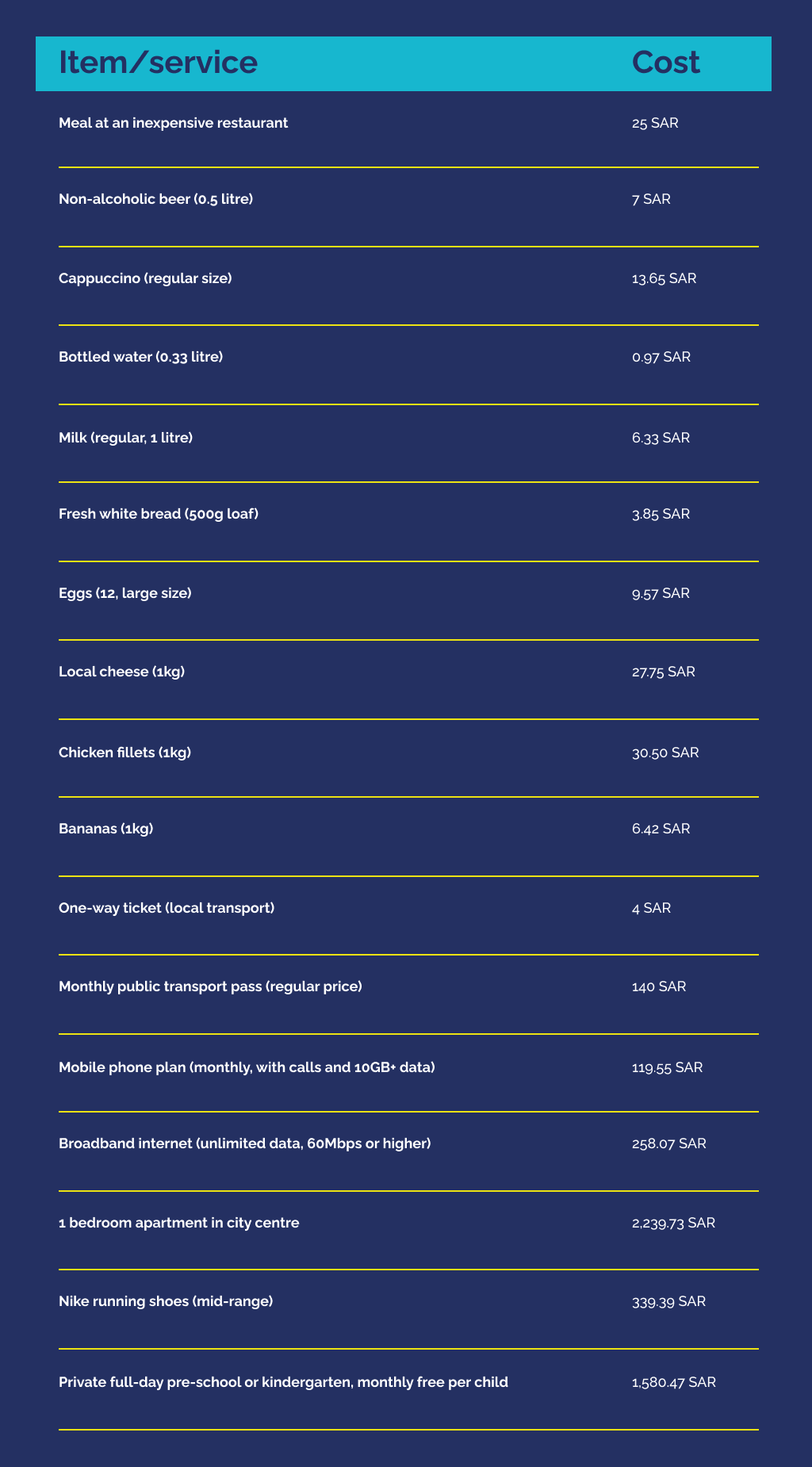
Transport is another area where lifestyle choices can really dictate how much money is in your pocket. As one of the world's leading oil producers, fuel prices in Saudi Arabia are exceptionally low, making driving a highly cost-effective option. For teachers relying on other forms of transport, ride-sharing apps like Uber and Careem are highly active and reasonably priced, while cities like Riyadh continue to roll out extensive public metro and bus networks to offer even cheaper transit alternatives. The table below breaks down some typical everyday living costs in Saudi Arabia.
According to early 2026 research, a single professional working in Riyadh needs around SAR 10,000 to SAR 18,000 per month (£1,972 – £3,550), to live comfortably, with rent being the main variable.
For a modest to average lifestyle in Riyadh, a single person can get by on SAR 7,000 to SAR 10,000 per month (£1,380 to £1,980), assuming shared housing or a studio in a less central area.
A more luxurious and upscale lifestyle in Riyadh requires a budget of around SAR 18,000 to SAR 25,000 per month for singles (£3,550 to £4,950), or SAR 45,000 to SAR 65,000 (£8,875 to £12,825) for a family of four with international schooling.
Housing or rent takes up a considerable amount of the monthly budget in Riyadh – more than in many other cities – often consuming 40 to 50 percent of total expenses. If however your rent is covered by your employer, this excessive cost is removed.
Saudi Arabia and the capital of Riyadh in particular is undergoing significant transformation. Since 2024, the government has rolled out the Riyadh Metro, with the aim of reducing the city's car dependency and changing how visitors and locals get around. The Orange Line was officially completed in January 2025. Although getting about has improved significantly, the affordability of housing and rent is a challenge in Riyadh. Rental pressures have become so significant that the government introduced a five-year rent freeze in 2025 to stabilise prices. Depending on whether or not rent is paid for as part of your teaching contract, this is something that teachers need to consider, as they may need to pay higher rent prices compared to the UK if they need to source their own accommodation in Saudi Arabia.
Hospitals and medical care in cities like Riyadh is generally excellent or world-class, with many facilities either meeting or surpassing European and North American standards. A standard private doctor consultation in Riyadh typically costs between SAR 150 (£29.65) and SAR 350 (£69.20), while specialist visits can range from SAR 300 to SAR 700 (£59 – £138). Expats in Riyadh most commonly recommend King Faisal Specialist Hospital and Research Centre for complex care, Dr. Sulaiman Al Habib Medical Group for outpatient services, and King Khaled Eye Specialist Hospital for eye care. As a teacher in Saudi Arabia you will be legally required to have private health insurance. Your employer or school should typically arrange cover as part of your residency process.
Saudi Arabia ranks as one of the safest countries in the world for street-level security, actively outperforming most Western nations in violent crime prevention. According to official data from the Kingdom’s General Authority for Statistics (GASTAT), an overwhelming 97.7% of residents report feeling completely safe walking alone at night in their neighbourhoods, earning the country the top safety spot among all G20 nations. Saudi Arabia is also a safe country for women to visit or travel around on their own.
Street crime, muggings and violent crime is exceptionally rare due to strict local laws, a highly active police presence and vast amounts of surveillance. For expats living in major urban centres like Riyadh and Jeddah, the day-to-day environment is remarkably secure. While physical crime isn't a major concern, road safety isn't as high as in countries like the UK. Despite modern infrastructure and extensive speed-trap systems, aggressive driving habits, high-speed tailgating and sudden lane changes make traffic accidents a main safety hazard in the country.
Teaching salaries in Saudi Arabia are highly competitive, but that doesn't mean you should accept the first offer without negotiating. Most international schools, universities and government programs expect a degree of polite back-and-forth. For this reason, many schools build a little wiggle room into their initial salary proposals. When negotiating, be as polite and professional and possible, as Saudi business culture is deeply rooted in personal relationships and hierarchy.
Under Saudi labour laws, your legally mandated lump-sum bonus (paid when you leave) is calculated strictly on your base salary, not your overall package. If a school offers an all-inclusive monthly sum, ask them to specify the split between your base salary and allowances (such as housing and transport). Push to keep your base salary component as high as possible (ideally around 60% to 65% of the total value). This ensures a much larger payout when you complete your contract.
I've you've taught specific curricula (like the International Baccalaureate or GCSE), hold a Master's degree or Ph.D, or specialise in high-demand STEM subjects, you can use this to negotiate a better salary. Quantify your achievements during the negotiation, focusing on your pass rates.
Many public or lower-tier schools operate on pay scales that are frankly non-negotiable. If the hiring manager won't budge on your general salary, switch the focus of the the conversation to rolled-in benefits, like health insurance that has dental or optical coverage thrown in too. Another option is negotiating for a larger housing allowance so you can secure a better apartment, paid tuition or education allowances for your dependents, or an extra flight home during mid-term breaks. These benefits can save so much money that it can balance things out.
At Teaching Abroad Direct, we help UK teachers secure positions in international schools around the world, including in Saudi Arabia
Visit www.teachingabroaddirect.co.uk to learn more about teaching opportunities overseas and for teaching jobs in Saudi Arabia and other locations across the Middle East.
Teaching Abroad Direct regularly speaks with British teachers currently working overseas.
Journalists interested in speaking with teachers currently working in other countries can contact us via [email protected]



