Teaching Abroad Direct
Moving abroad to teach is an exciting milestone in life that many educators will remember for the rest of their lives. Few people however talk about one of the common realities of beginning life as an international teacher... and that's experiencing culture shock. Whether you're taking on a primary class in South East Asia or teaching secondary science in the Gulf, it's totally normal to find that once the initial excitement settles, the reality of lesson planning, school admin and daily errands can hit really hard. Culture shock can affect anyone moving to a new country for work, and it impacts teachers across all subjects and school types (not just first-timers).
If you’re currently adjusting to teaching in a new country and think you may be dealing with culture shock, you aren't alone and you can overcome it if you give your body and mind time to adjust.
Here's our straightforward guide to overcoming culture shock when teaching abroad, including how to protect your mental health, keep busy and be prepared so you can thrive throughout your international teaching journey.
We get culture shock when we experience confusion, anxiety, uncertainty and a general sense of struggle in adapting to a new country. There are four stages to culture shock:
Culture shock is very common when you leave the familiarity of home and step into an entirely new, unfamiliar environment. For expat teachers, this transition can feel particularly intense, especially if they've moved from a village or quiet town to a bustling city, or have relocated to a country with vastly different social norms (such as those in the Middle East). Because it happens in stages and can creep up slowly, culture shock can be surprisingly hard to pinpoint when you're right in the middle of it and experiencing it in real time. The good news is that it doesn’t last forever. As you build a routine, get used to local customs, navigate public transport with ease and make connections with other teachers and local people, the initial anxiety will fade. Once the adjustment period passes, many teachers have a deeper appreciation for their chosen country.
For international teachers, culture shock can hit differently. While the average expat might only need to handle foreign grocery stores and utility bills, teachers are trying to navigate a new culture while managing a full classroom, adapting to a new curriculum and learning complex school bureaucracy and admin. Teachers also have to manage vastly different student behaviours and parental expectations. Balancing full-time teaching duties while processing a complete lifestyle overhaul is precisely why expat teaching fatigue hits teachers so hard, which is why protecting your mental health should be a high priority.
International schools face many challenges when it comes to teacher retention, and culture shock can be a contributing factor to this. High turnover rates, with teachers often staying only two to three years before moving on, remain a persistent issue. Recent research shows that turnover in international schools can reach as high as 25-30% annually – a rate significantly higher than in public and national schools
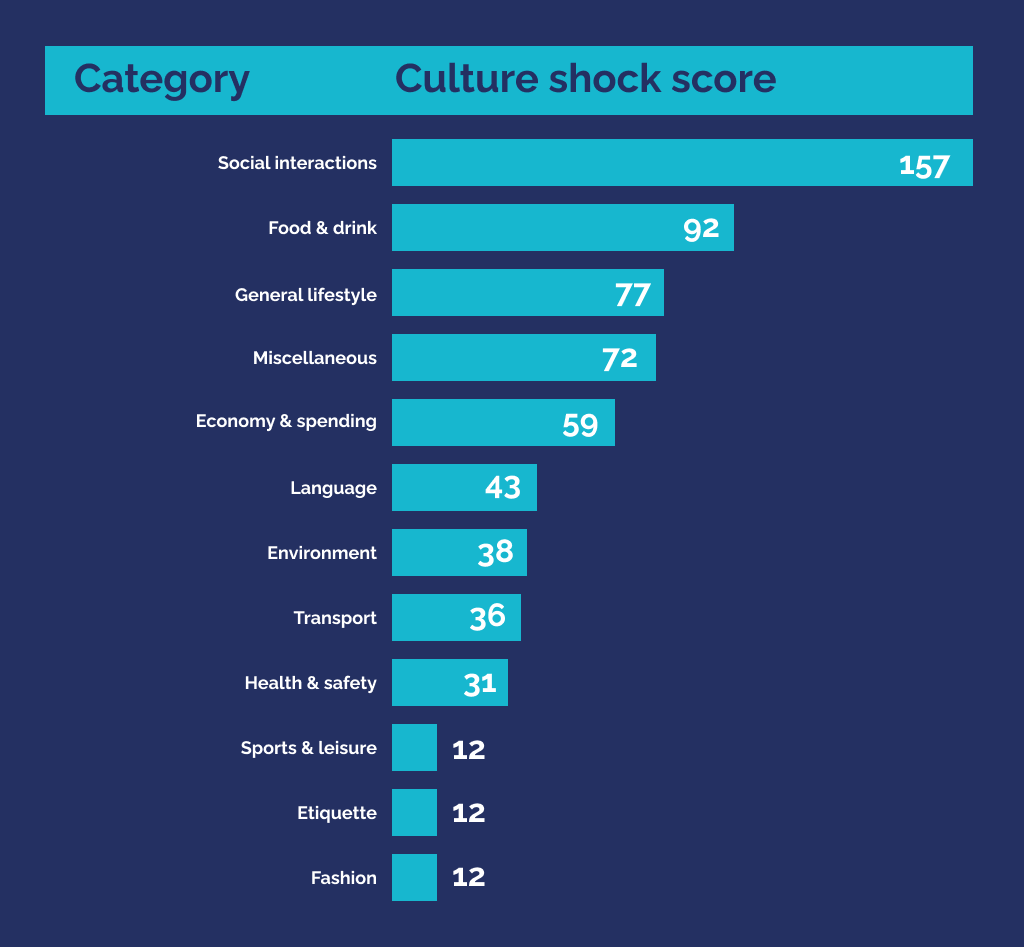
According to research from insurance group William Russell, the most common culture shocks experienced by expats who move abroad involve social interactions, food and drink and lifestyle changes. Of the 648 culture shocks studied, 157 were linked to social interactions. This was closely followed by dietary changes, i.e. eating different local produce and adjusting to new eating times. The below table expands more on some of the other common culture shocks for expats.
In her research on international educators, academic Rebecca Stroud Stasel highlights that culture shock is a universal reality for teachers moving overseas. Citing landmark studies on sojourner adjustment, she claims that all international teachers face some type of culture shock and that it's a part of the process. The shock isn't experienced because the teachers are unprepared, but because they undergo a double-layered adjustment. Not just adapting to a foreign city, but navigating an entirely new organisational culture inside school walls at the same time.
The InterNations Expat Insider report is one of the world's largest annual surveys of expat life. For 2026, around 8,000 expats across 162 nationalities were surveyed. The easiest countries for expats to settle in and feel at home are Mexico (1), followed by Panama (2), Thailand (3), Brazil (4), and the UAE (5). Mexico ranks first due to the ease of finding friends, local friendly people and general culture. That said, Mexico ranks 25th in the report's safety and security subcategory, with just 68% of expats having a positive view of their personal safety, compared to 81% globally.
Now you have more of an understanding of what culture shock is, here are some simple steps when navigating it as an expat teacher.
Research your destination school before your departure. Keep in mind that job adverts and school marketing brochures paint a glossy image of what life will be like. While it's true that you'll have an amazing time as a teacher, doing thorough research will give you an accurate view of what your day-to-day professional and personal life will look like.
Find out how your destination school operates and your exact teaching timetable. How much time will you spend teaching? Planning lessons? Marking? This will help you to feel more prepared for how to structure your days. Also take the time to look through any hidden contractual obligations like mandatory weekend events, heavy playground duty rotas or unpaid extracurricular activities. This prevents you from walking head-first into unexpected 50-plus hour working weeks. Knowing whether a school expects rigid, daily lesson submissions or uses complex software also allows you to get comfortable with their technologies.
When packing your wardrobe, remember that 'professional' means different things in different cultures.
If you're staying in the Gulf Region (Dubai, Qatar, UAE, etc.), then expectations will be different compared to British standards. In the Middle East, male teachers are expected to wear buttoned-up shirts, ties and formal dress shoes. Women should wear smart trousers, blouses or modest dresses. Layering is an important part of navigating temperatures indoors and outdoors – while temperatures outside soar, blast-chilled air conditioning inside requires cardigans or light jackets to keep warm while maintaining modest coverage.
If you're travelling to Southeast Asia to countries like Thailand, Vietnam and Indonesia, lightweight, breathable fabrics like linen and cotton should be your go-to choices. While society isn't as conservative as in the Gulf region, local cultural norms should be respected. In Thailand and Indonesia, teachers are held in high societal regard as cultural authority figures. Showing up in overly casual beachwear or shirts without collars can alienate local colleagues and leadership. There may also be rules about tattoos and piercings. If in doubt, before your position begins, ask HR for a copy of the staff handbook.
It's also a good idea to connect with other social media teaching communities on certain platforms like Facebook. Region-specific forums may have answers to immediate questions about things like setting up bank accounts, sourcing furniture, supermarket availability and SIM cards etc.
Relocating to teach abroad requires dropping the mindset of how you did things back home. Measuring a new international school against your previous system is a very fast route to frustration and burnout... not to mention friction with colleagues! Every international system carries its own operational quirks. In Middle Eastern private schools, instructions usually come from school owners and regulatory bodies directly. Elsewhere there may be more unanimous consensus-based models. To adapt successfully, come in as an observer and learn to navigate local chains of command gracefully rather than push or rebel against them.
Equally important is adjusting your expectations around parental involvement and classroom dynamics. In many Asian international schools, for instance, intense parental engagement is deeply culturally rooted, meaning you may encounter daily communication via messaging apps and high expectations from parents regarding academic outcomes.
Speaking the local language is the best way to immerse yourself into a new country and culture. Suddenly the expat barrier lowers and it reduces everyday friction with everyone from taxi drivers and colleagues to shopkeepers, market sellers and so on. Even if your school is international and mainly English speaking, learning conversational phrases will enable you to connect with local people far easily, making interactions less frustrating. Locals will really appreciate the effort you've made in learning their language, and will likely be interested in hearing more about you, why you decided to become a teacher, and what brought you to their country. They'll also likely introduce you to more customs, people and food. You'll also be able to make friends more easily outside of the expat community.
Then there's connecting with parents. Speaking basic local phrases helps you communicate with parents who do not speak English. In learning a language yourself, you can also better understand why bi-lingual students make specific mistakes by knowing how their native language works. You'll also experience the first-hand struggle of learning a new language, which should make you a more patient and understanding teacher.
When you step into school accommodation after a long flight, the initial reality can feel a bit sterile. Prepare yourself mentally – furnished expat apartments often feel sparse and basic. Expect neutral walls, simple furniture and lighting that feels clinical. It's your job to turn it into a place to live and to see the potential. This will help with your culture shock, especially because your first term teaching abroad involves high amounts of social and professional energy. Your apartment shouldn't just be where you sleep – it needs to be a calming personal sanctuary where you can truly recharge after a demanding school day.
Making a space feel like home doesn't require a full interior redesign. It’s about surrounding yourself with small, familiar sensory anchors. Before leaving home, pack items in your case that bring you comfort and stability. If you have the address of your apartment, get some items sent there in advance if someone can sign for them. Or you can purchase things at local markets and shops once you arrive at your destination. Think soft furnishings like rugs, cushions, bedding and throws, as well as warm bedside lamps and bath towels. Print out family photos, framed art prints or bring small decorative keepsakes to place on open shelving. Replacing bare walls with familiar faces or bright and colourful posters to keep you grounded during moments of homesickness. You can also display fake or real house plants to add a touch of calming green nature to the space.
Never underestimate the psychological power of a familiar taste. Consider packing non-perishable comfort foods like a certain brand of tea bags or coffee, local spices, a jar of pickle or sweets you can only get in the UK. This will give you an immediate taste of home when culture shock hits.
Schools in major expat hubs like Dubai, Doha, Singapore and Bangkok offer well-established international school networks designed specifically to help new teachers get to grips with their induction weeks. Take advantage of dedicated 'buddy programmes' if you have them. Some schools also place staff in the same apartment complex or within a dedicated residential neighbourhood. Living close to your colleagues can make social integration much easier. These shared living spaces mean impromptu week-night dinners, joint grocery runs and immediate carpooling networks that can be built right into your daily routine.
Don't be afraid to speak to other expat teachers in your department. These educators have already survived their first year in the job, and know the unwritten 'rules' for both the school and the host country. They'll also know the exact local workarounds for things like setting up local utility apps, banking, which admin deadlines are stricter than others, how to communicate with parents, the best local doctors, gym membership and so on.
That said, while staff room camaraderie is an absolute lifesaver during your first term, don't let it consume your entire personal life. Only interacting with your fellow teachers means conversation inevitably defaults to marking piles, lesson plans, difficult student behaviours and school politics. To protect your mental health and prevent early burnout, it's really important to establish relationships that are completely detached from your workplace. You can do this by pursuing interests outside of campus – whether that's joining a gym or exercise group, or doing volunteer work. This way you create a healthy boundary between your career and your personal life.
The weekends are there to be enjoyed, to forget about marking and to start exploring your new home. Making a conscious effort to step outside your front door every weekend helps you build positive emotional associations with your host country, which can help culture shock.
Head to local night markets or street food stalls. Sampling local dishes is one of the quickest ways to feel grounded and connected to your new environment. Plan day trips, do a walking tour (if you're in a city), and plan little adventures that remind you why you moved countries in the first place.
If you're teaching teaching in Thailand or South Korea for example, spend Saturday island-hopping or visiting local attractions. If you're based in the Gulf, book a desert safari, go beach-hopping along the coast, or treat yourself to a shopping session. During heavy marking weeks when long-distance travel isn't feasible, book a night at a boutique hotel or resort in your city. Changing your scenery for even 24 hours provides a mental reset. (As they say, a change is as good as a rest...).
By actively filling your weekends with local exploration rather than passive screen time, you stop feeling like a temporary worker surviving a contract, and more like an expat teacher on the adventure of a lifetime.
Teaching Abroad Direct helps UK teachers secure positions in international schools in many countries right around the world.
Visit our website to browse various international teaching jobs.
Teaching Abroad Direct regularly speaks with British teachers currently working overseas.
Journalists interested in speaking with teachers currently working in other countries can contact us via [email protected]



