Teaching Abroad Direct
Dubai is one of the most visited cities in the world and is now a leading travel destination thanks to its iconic skyscrapers, luxury beach clubs, shopping malls and comfortable lifestyle. It's an attractive destination for teachers from all over the world, with more than 27,000 teachers working in private schools and calling the place home. Indian teachers make up the largest nationality group of teachers, followed by British and Egyptian expats.
But with its culture being renowned for such a high-end and luxurious lifestyle, can you actually save money in Dubai? The short answer is yes – you can. Despite Dubai’s glamorous reputation, relocating to the UAE remains one of the most lucrative career moves a teacher can make. Thanks to the tax-free teacher salary Dubai schools generally offer, along with free school-provided housing or generous benefits like accommodation allowance, most teachers realistically can save anywhere from 20% to 50% of their gross income every month, depending on how they spend money when they are actually living in Dubai.
Whether you're curious about taking up a job in Dubai as an international school teacher or you're thinking of teaching English in Dubai, the key to building a healthy savings pot comes down to understanding how compensation packages are structured.
In this blog, we'll break down real monthly budgets, explore realistic savings numbers across different roles teaching in Dubai, and highlight some of the financial perks that make a Dubai teacher's salary and savings packages so hard to beat.
A huge buzzword about teaching in Dubai is 'tax-free' when it comes to wages. Income is tax-free and teachers aren't paying the 20-40% of income tax on their pay that they would in the UK. Every single dirham you earn is yours to keep, spend or save. But tax-free isn't the only benefit and doesn't fully describe the value of a teacher's salary in Dubai. For international school teachers, the real value goes far beyond the monthly figure on a contract.
Your package isn’t just a monthly salary – it’s the housing your school provides, the health insurance premiums you’ll never pay, tuition fees for your children (if you have them) and the paid costs of annual return flights home each year.
The average range for a tax-free teacher salary in the UAE (for an entry-level teacher) is $18,800 (£14,229) – $45,000 (£34,070). The average figure is $34,700 (£26,274). For a highly experienced teacher without management responsibilities the average range is $24,000 (£18,174) – $75,300 (£57,014), with an average figure of $48,300 (£36,571).
Entry-level English teachers with a TEFL/TESOL certification and a bachelor's degree can typically earn between $2,000 (£1,514) and $4,000 (£3,029) per month. Experienced English teachers with many years of experience and advanced degrees like a Master's in TESOL or education can earn between £3,029 and £4,543 per month or even more.
Teachers working in international schools or universities may command higher salaries, often ranging from $3,000 (£2,271) to $7,000 (£5,300) per month, depending on qualifications and experience. Additionally, many teaching positions in the Middle East offer benefits such as accommodation, health insurance, flights home and tax-free salaries, making the overall compensation package very attractive for English teachers.
Your earnings and savings potential won’t be one-size-fits-all. A teacher’s take-home pay in Dubai varies significantly based on several factors, such as the type and tier of institution you teach in, your level of experience and leadership responsibilities. Keep in mind that established tier-1 British or American international schools typically offer higher pay than newer or local private curriculum schools. A school's rating can also determine salary, with institutions ranked 'good' or 'outstanding' KHDA offering teachers more pay.
The specific qualifications you hold (such as QTS or a PGCE versus a TEFL certificate), are also factored in, as well as the subjects you teach. Teachers who are STEM specialists and have extensive experience in subjects such as computer science, mathematics, physics and chemistry are consistently sought after and tend to give teachers better starting packages than generalist positions. Special educational needs (SEN) specialists and early years teachers are also well-positioned in the UAE market.
Your personal lifestyle choices will also determine how much disposable income you have – whether you prefer dining out at trending hot spots or cooking home-cooked meals, driving a leased luxury car versus using public transport, and how frequently you travel on school holidays and days off (and any luxury purchases you splurge on).
One of the reasons teachers can save so much working in Dubai is because they get plenty of benefits and perks alongside their salary, which makes the cost of living far cheaper. For instance, many schools provide free accommodation to teachers, or they provide an accommodation allowance for the teacher to choose their own. This also includes covering any dependents such as the teacher's children and/or partner if applicable. Most accommodation will come furnished with basic furniture.
Schools also pay for teachers’ flights to and from their home country every year, including flights for dependents. The amount given to teachers for flights will depend on the institution's budget and costs. Many schools also offer a 'relocation allowance' of between £300-500 to pay for visas and associated paperwork.
Almost all schools in Dubai offer teachers end-of-contract bonuses, or waived school fees for their children if they wish for them to attend the same school. Many perks and bonuses will however depend on your experience as a professional, your performance in your chosen role and the strength of your position in the job market.
The majority of international schools across the UAE either provide fully furnished, school-managed accommodation (often a modern apartment or villa), or give you a tax-free housing allowance. These stipends generally range from AED 60,000 (£12,360) to AED 150,000 (£30,921) annually. At the top end of that bracket, the housing allowance alone is worth more than the total net take-home salary of many state-school educators back in the UK. According to teachertakehomepay.co.uk, the net take home pay of a qualified teacher in England and Wales is £25,465.36.
If your school supplies accommodation directly, your rent expense drops to zero. Housing represents the single largest cost of living in the Middle East, making this benefit the primary dividing line between a standard contract and a truly outstanding one.
Standard contracts in the Gulf include employer-covered return economy flights to your home country once per year. Many institutions extend this perk to cover immediate dependents as well. Considering a return flight between London and Dubai typically costs between £700 and £1,300 per seat, a couple can save considerably each year on travel costs alone.
UAE labour legislation requires all employers to give staff medical coverage. For international school teachers, this usually translates to comprehensive, fully paid health plans rather than a basic subsidised scheme. When reviewing a contract, always check whether your dependents are covered under the policy, examine which local clinics and hospital networks are included, and verify if dental and optical treatments are part of the policy. This can save you a lot of money while providing you and your family with high-end medical care.
Under UAE labour law, departing employees are entitled to a tax-free lump-sum payout known as an end-of-service gratuity. The basic calculation awards 21 days of base salary per year worked for your first five years, increasing to 30 days per year for subsequent years. For example, on a standard two-year contract earning AED 15,000 (£3,092) a month, your end-of-service payout will come to roughly AED 21,000 (£4,328.97) upon completion. Some teachers use this end-of-contract windfall to fund their next overseas move, or save it towards a large purchase such as the deposit for a UK property.
For educators relocating with family, tuition benefits can completely transform your household finances. Tuition fees at top UAE international schools routinely run between AED 30,000 (£6,184) and AED 100,000+ (£20,614+) per student per year. Luckily, schools almost always provide staff with discounted or entirely free tuition spots for their children (typically ranging from 50% to 100% off standard rates). If for instance a school charges AED 80,000 per pupil and offers a 75% staff tuition reduction, you save AED 60,000 per child every year. A family raising two children in this position avoids AED 120,000 in out-of-pocket educational costs that non-teaching expat families must pay in full.
A mid career teacher with five years of experience may be on a salary of AED 18,000 (£3,710) a month. Here's what a standard salary and savings package might look like.
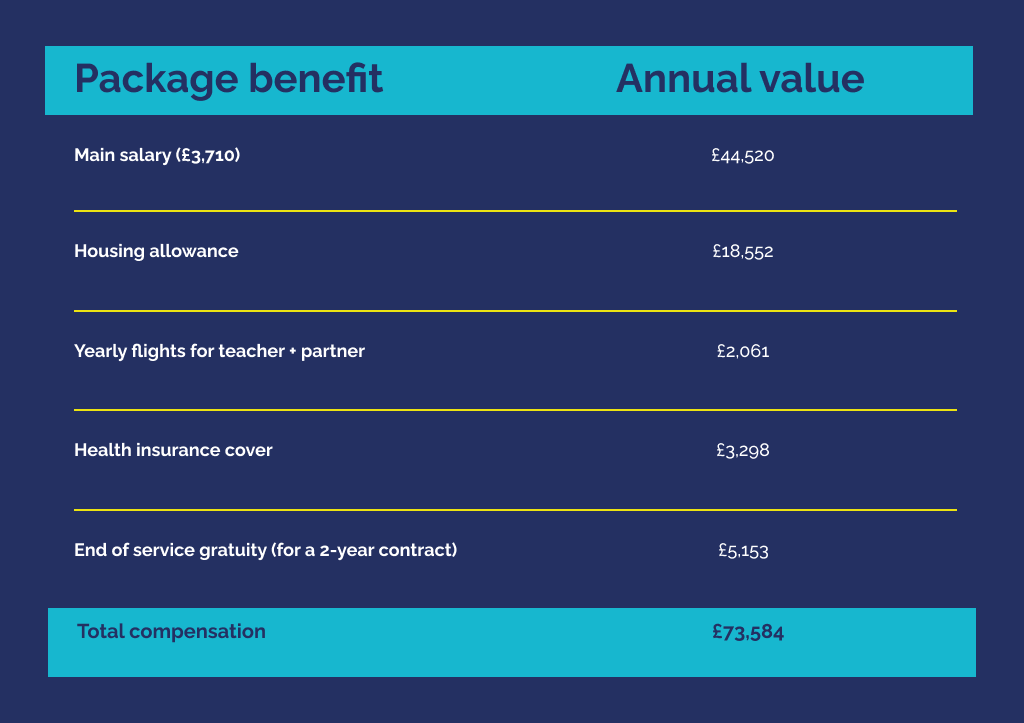
Zero tax is payable on this total figure. If you earned this amount in the UK, your tax calculations would look like the following:
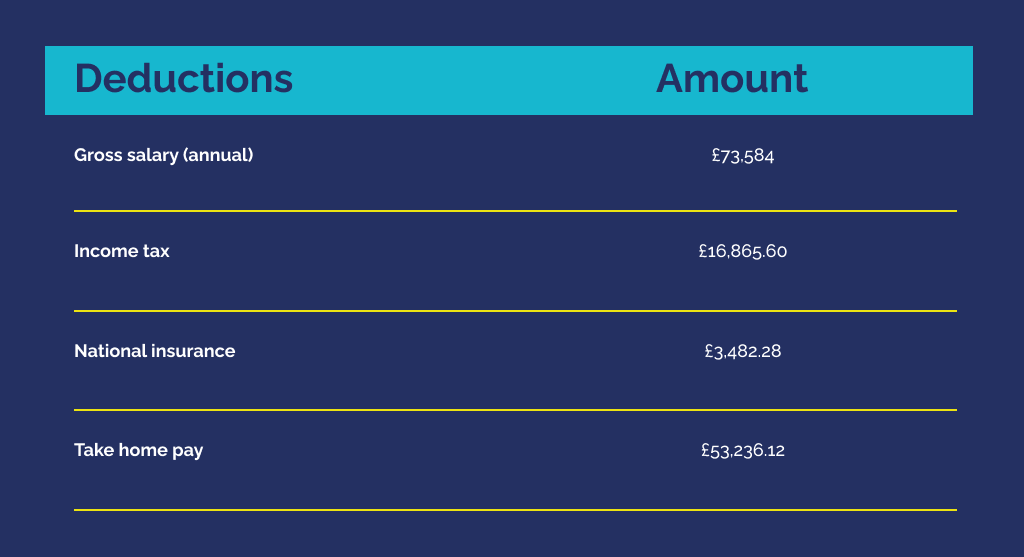
The UAE doesn't charge personal income tax on wages. This has been a long-standing policy that instantly maximises what foreign teachers can take home. Unlike in the UK, there are no deductions for Pay As You Earn (PAYE) income tax, National Insurance contributions or compulsory pension schemes. The total salary figure printed on your Dubai contract is the exact amount deposited into your bank account on payday.
To help you compare, below is a UK teaching salary against an equivalent UAE income.
In the UK (Main Pay Scale 4 - £40,940/year (£3,412/month gross): income tax takes roughly £3,350, National Insurance takes about £1,500 and mandatory Teachers’ Pension Scheme (TPS) contributions add another £3,640 (at 8.9%). These deductions eat away over £8,490 a year, leaving you with roughly £2,750 per month after tax, or £2,450 per month if you remain opted into the pension scheme.
In the UK (Main Pay Scale 6 - £46,939/year (£3,912/month gross): income tax takes around £6,870, National Insurance takes £2,750 and TPS pension contributions total roughly £4,180. These compulsory deductions reduce your monthly earnings from £3,912 gross down to roughly £3,110 per month after tax, or £2,760 per month after pension.
In the UAE, none of these mandatory government deductions exist. A Dubai teacher on an equivalent gross contract retains 100% of their earnings. Because your accommodation and health insurance are provided on top, virtually that entire sum remains disposable.
That said, while the UAE won't tax your earnings, HMRC rules still apply when moving abroad. You need to ensure you meet the criteria for non-residency for tax purposes (via HMRC’s Statutory Residence Test and P85 form) so you don't face unexpected UK tax liabilities on your foreign income while overseas or when you return home. Consulting an international tax adviser before making a move abroad is always recommended.
On average, British teachers in Dubai who have relocated for work should be able to save around 26% of their income. That figure is lower than some other international destinations, because the UAE and Dubai especially has a higher cost of living compared to other countries such as those in South East Asia.
Teachers who arrive in Dubai expecting huge savings can sometimes discover that the lifestyle can cost more than they expected. Dubai has the temptation of high-end restaurants, beach clubs, desert activities, plenty of opportunities for shopping and a social scene that costs money. Many teachers have to make a careful balance between enjoying the experience fully and putting money aside in savings.
The table below based on data from Gulf Teach demonstrates how much a teacher can put aside in savings based on budget, lifestyle and salary. These figures assume that all accommodation is provided by the teacher's school. For teachers who don't have accommodation provided or a housing allowance provided, rental costs should be added to monthly expenses. Figures are based on conversion rates as of October 2026.
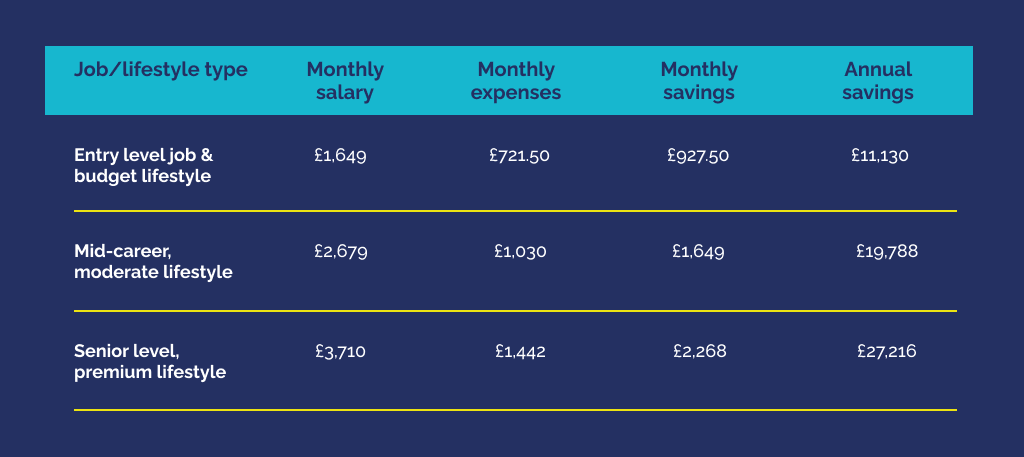
According to DMCC, when it comes to food costs in Dubai, a litre of milk costs around AED 6.61 (£1.36), a dozen eggs AED 12.30 (£2.54), while a kilo of chicken fillets costs AED 32.65 (£6.73). Eating out can range from AED 45 (£9.28) for a meal at an inexpensive restaurant to around AED 300 (£61.84) for dinner for two at a mid-range eatery. Cooking at home can significantly reduces food costs without sacrificing quality, and the range available within Dubai’s supermarkets is vast.
If your school provides transport, costs are minimal. Otherwise, teachers should budget AED 500-1,500 (£103-£309 a month) for car rental, petrol or taxis/e-hailing. The Dubai Metro is efficient for commuting along its routes, but doesn't cover all school locations. According to latest figures from wise.com, a single ticket on public transport is £1.21, a monthly pass is £50.35, and petrol is £0.70 a litre. A 1 km journey in a taxi at a standard tariff is £0.52.
Your day-to-day habits in Dubai will have a big impact on your bank balance than almost any other factor. How you choose to spend your weekends creates a massive divide between high-savers and those living month-to-month. A teacher who regularly attends weekend bottomless brunches, dines out at top restaurants and visits private beach clubs can easily burn through AED 3,000 to AED 5,000 (£650 – £1,100) per month on leisure alone. In contrast, a teacher who takes advantage of Dubai’s free public beaches, spends more time relaxing at home and enjoys low-cost outdoor activities can comfortably keep social expenses down to AED 500 to AED 1,000 (£110 – £220) per month.
Neither approach is wrong, but being conscious of a balance is what turns a good salary into real wealth.
Teaching Abroad Direct helps UK teachers secure English teaching positions in international schools in Dubai.
Visit www.teachingabroaddirect.co.uk to learn more about English teaching opportunities overseas and for teaching jobs in Dubai.
Teaching Abroad Direct regularly speaks with British teachers currently working overseas.
Journalists interested in speaking with teachers currently working in Dubai can contact us via [email protected]


