Teaching Abroad Direct
Few nations have transformed their education sector as quickly as the United Arab Emirates. According to Talk Education, over the last 50 years, investment in schooling has been so great that it's led to the adult literacy rate in the UAE almost doubling what it previously was in the mid- 1970s. Nowadays, some of the world's most sought after schools can be found in the UAE. Education is compulsory from the ages of 6-18 in the UAE, and schools across the country have evolved from humble, community spaces into some of the most technologically advanced and innovative learning institutions in the world. The UAE also has the largest concentration of international schools in the world, with instruction given in English.
To understand how education in the UAE has changed and evolved over the years, it's important to take a careful look at classroom setups and technology changes, and how these have shaped the schooling system. Long before the rise of smart boards, tablets and eco-friendly campuses, education was rooted in local traditions and created around the region's climate, culture and available resources. As the nation grew (fuelled by pearl trading, shipping trade and eventually the discovery of oil), so did its commitment to developing a world-class education system.
In this blog, we'll take you through a history of UAE education, starting with the opening of the first formal school in 1912 and right through to the groundbreaking flexible learning spaces of Abu Dhabi and Dubai today.
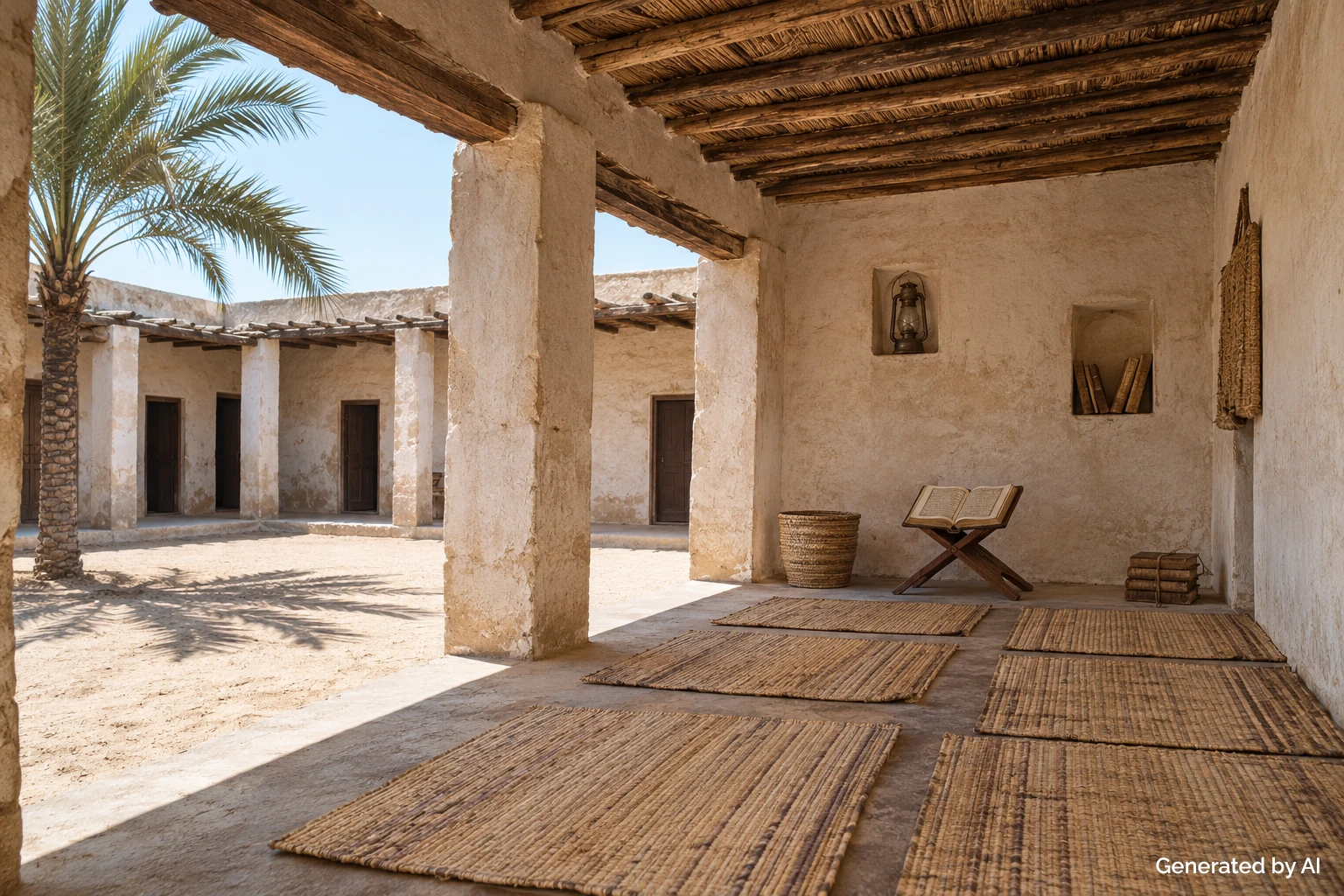
There is actually some debate over the first school in the UAE based on various definitions. It all depends on whether a historian considers 'first' to be based on dedicated architectural structure, early formal curriculum, or public state sponsorship. There are actually three different schools which lay claim to the title.
This school is often cited as the earliest formal institution in Sharjah (initially founded as Al Taimiyyah in 1907 by Sheikh Mohammed bin Ali Al Mahmoud, and later re-established as Al Eslah in 1935). The school introduced formal classroom grading, fixed monthly tuition and standardised text-based curricula. Its building is now a museum in the present day. Only the children of rich parents could attend Al Eslah, which in 1935 (then also known as Al Qassemia School), charged a monthly fee of two Indian rupees.
Dubai’s first purpose-built, semi-formal school building was funded by pearl merchant Sheikh Ahmed bin Dalmouk, with regional scholars and structured classrooms. The school is widely recognised by cultural authorities as the region's first purpose-built, semi-formal school structure that moved students out of private living quarters into a dedicated civic building. Teachers were brought in from destinations overseas and across the UAE to teach students. It was restored in the 1990s and transformed into a local heritage museum in 2000.
This school was the first government-established public school in Abu Dhabi emirate under Sheikh Zayed bin Sultan Al Nahyan's early vision. It's seen as an institution that marked the transition towards modern public state education under the leadership of Sheikh Zayed bin Sultan Al Nahyan.
Rather than competing with one another, it's fair to say that all three early schools collectively represent the regional transition from informal Katatib (where a local religious teacher known as a Mutaw'a taught basic Quranic literacy under palm trees or in private homes) to more structured, physical educational buildings with formal teachers.
It's also important to consider that before the United Arab Emirates was established as a unified sovereign nation in1971, the region existed as a collection of independent coastal Sheikhdoms collectively known as the Trucial States (or Trucial Coast). These states were bound by individual shipping treaties with the UK during the 19th and early 20th centuries, but emirates like Dubai, Sharjah and Abu Dhabi managed their own domestic affairs and educational initiatives independently. All of the country's 'first schools' pre-date the formation of the modern country. These pre-federation institutions were founded by local rulers, visionary scholars and wealthy pearl merchants, but they became the foundations upon which a national education system was built after unification and the creation of the UAE.
The image shown is a re-imagination of what the first school in the UAE may have looked like. Schools of the time were designed around shaded verandahs (Liwan) and central open-air courtyards. The wide covered walkway shown in the image shielded students from direct sunlight and the heat of the day while ensuring that any natural breeze could circulate across the sandy courtyard. The thick, rustic plaster and coral-stone masonry provided natural thermal insulation, keeping the interior significantly cooler than the surrounding desert heat.
The image showcases woven palm mats laid directly across the stone floor, positioned in front of low wooden reading stands. The central placement of the open book on a crossed wooden stand highlights the curriculum of the era, which was deeply rooted in Islamic philosophy, law and science, Arabic grammar and teachings of the Quran. The brass oil lamp highlights how classrooms of the era relied on daylight hours, oral recitation and scarce written materials long before printed textbooks became widely available.
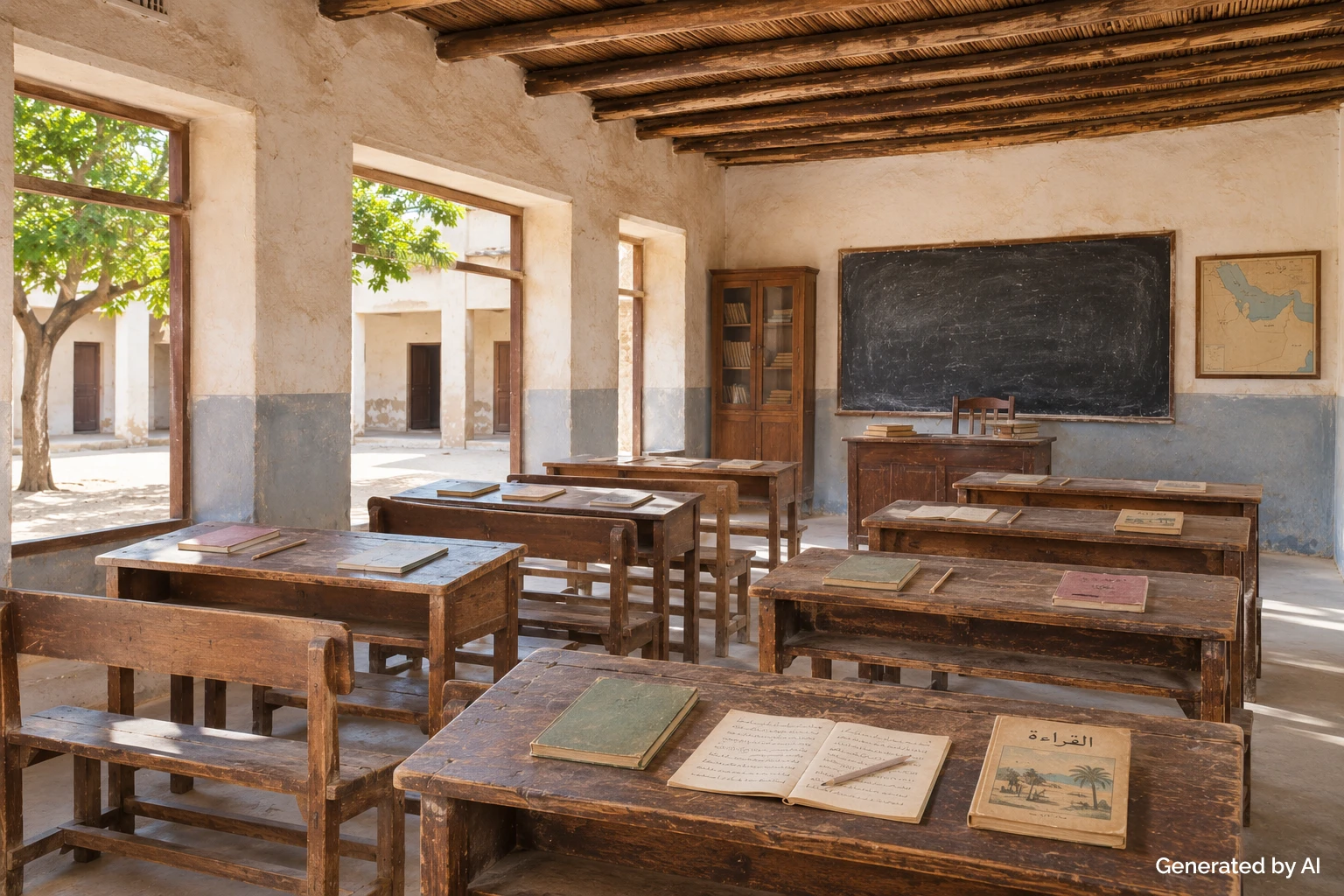
As trade expanded and civic administration grew increasingly complex, regional leaders recognised the need for a standard academic framework that covered all subjects such as literacy, maths, science, geography and so on. Al Qasimiya School, the first formal school in the UAE, was established in 1953 and became a notable institution, with graduates including His Highness Sheikh Dr. Sultan bin Muhammad Al Qasimi, Ruler of Sharjah. After it stopped operating as a school, it was turned into a cultural complex in 2018 that now hosts the Sharjah Architecture Triennial, preserving its architectural legacy.
Arabic grammar, literature and calligraphy evolved during this time, rather than a sole focus on basic reading ability. This was paired with structured studies in Islamic values and ethics, ensuring that academic modernisation remained deeply anchored in regional cultural and moral ways of life. Academic records from the Sharjah Museums Authority highlight how early text materials and calligraphic exercises were curated during this time.
Driven by the coast's reliance on shipping and trade with places like India and the wider Gulf, arithmetic instruction evolved to meet practical economic needs. Students were taught commercial book-keeping, how to perform mental arithmetic, interest/trade balance calculations and currency conversion logic (and particularly handling the Gulf rupee). This ensured that a new generation of Emiratis were ready to manage regional trading houses and early administrative offices.
To broaden students' understanding of the world beyond the Trucial Coast, schools introduced formal geography and social studies. Lessons covered regional topography, international trade routes, meteorology and world history. Students studied global maps and earth sciences, helping them realise where the UAE was positioned within global trading networks.
Previously, assessing a student's progression was primarily based on their attendance or individual recitation speed. By the 1950s, things had changed and schools had their own formal grading systems, end-of-term examinations and merit-based academic promotion. Students received formal report cards evaluating subject mastery, marking the true birth of modern school administration in the region.
By the 1950s, schools moved away from floor-seated circles, and focused on spaces and rooms that were designed for tuition. Schools began dividing students into grade levels, and a blackboard was introduced so teachers could teach directly to a group. Teachers could now demonstrate mathematical equations, write Arabic poetry and draw maps for an entire room simultaneously. Partnerships were formed with other countries in the region (such as Kuwait, Egypt and Qatar), and schools began receiving mass-printed textbooks, formal exercise notebooks and graphite pencils. This marked a big shift from scarcely handwritten manuscripts to standardised educational materials available to every child in the room.
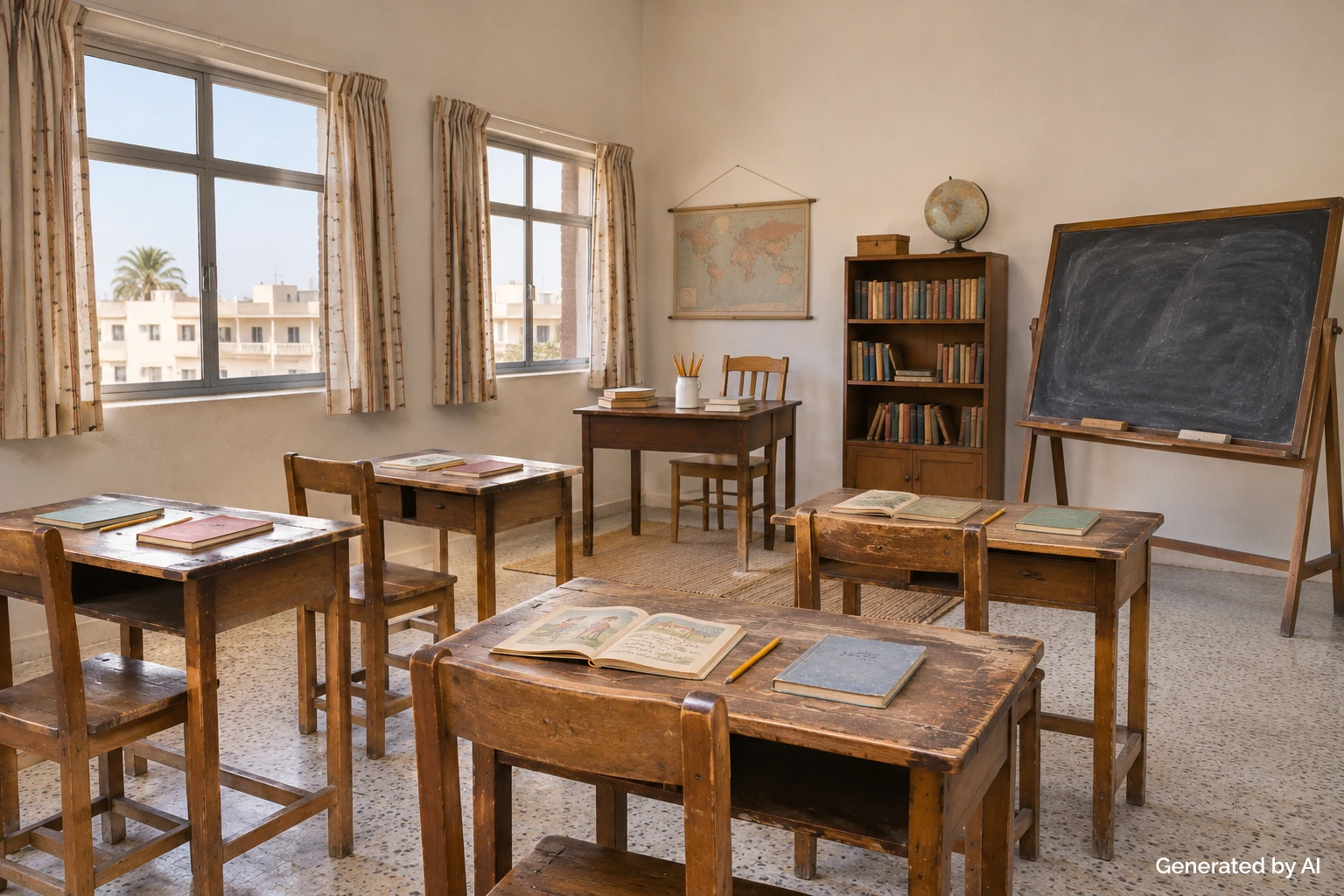
The UAE's international school sector began with the opening of DESS (Dubai English Speaking Schools). In 1963, a group of 10 students assembled at a small block of flats, where they were taught by a British airman who was on loan from the Sharjah RAF base. The school was created to educate the children of early British expats, military personnel and foreign company workers. The school's first headteacher, Harry Atkinson, was appointed a year later.
The school moved to its Oud Metha site in 1967, forming its Board of Trustees in 1969. This decade was defined by dramatic transition. Oil had just been discovered, and the United Arab Emirates wasn't yet a unified nation. That said, cities like Dubai were rapidly expanding beyond trading posts. By 1963, students had the choice to either attend expat institutions like the Dubai English Speaking School (DESS) or a local semi-formal/public school.
With few paved roads, there was little traffic and and no air-conditioned vehicles. Many children travelled to school on foot, by bike or even by riding traditional wooden water taxis. Classrooms relied on ceiling fans, cross-breezes through open windows and early morning schedules to finish before the punishing afternoon heat set in. Cities like Dubai and Abu Dhabi had a small town feel to the community, which was tight-knit. At expat schools, the curriculum followed traditional British primary standards (reading, writing, arithmetic and nature studies). As you'd expect, kids having their education in the UAE had the open desert as their playground.
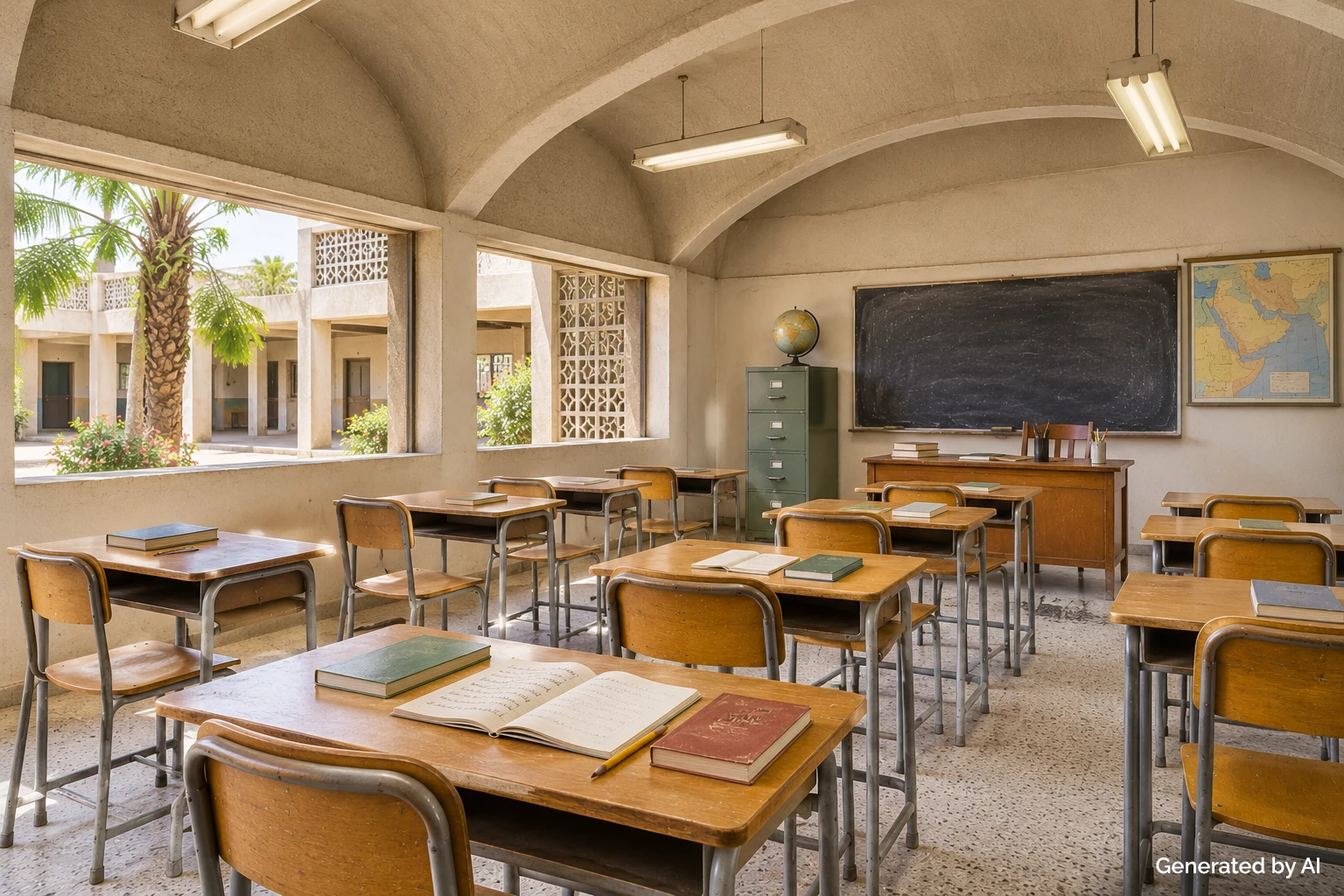
As the imagery suggests, by the 1960s, growth in the region had introduced new industrial building materials such as terrazzo tile flooring and glass-paned metal windows.
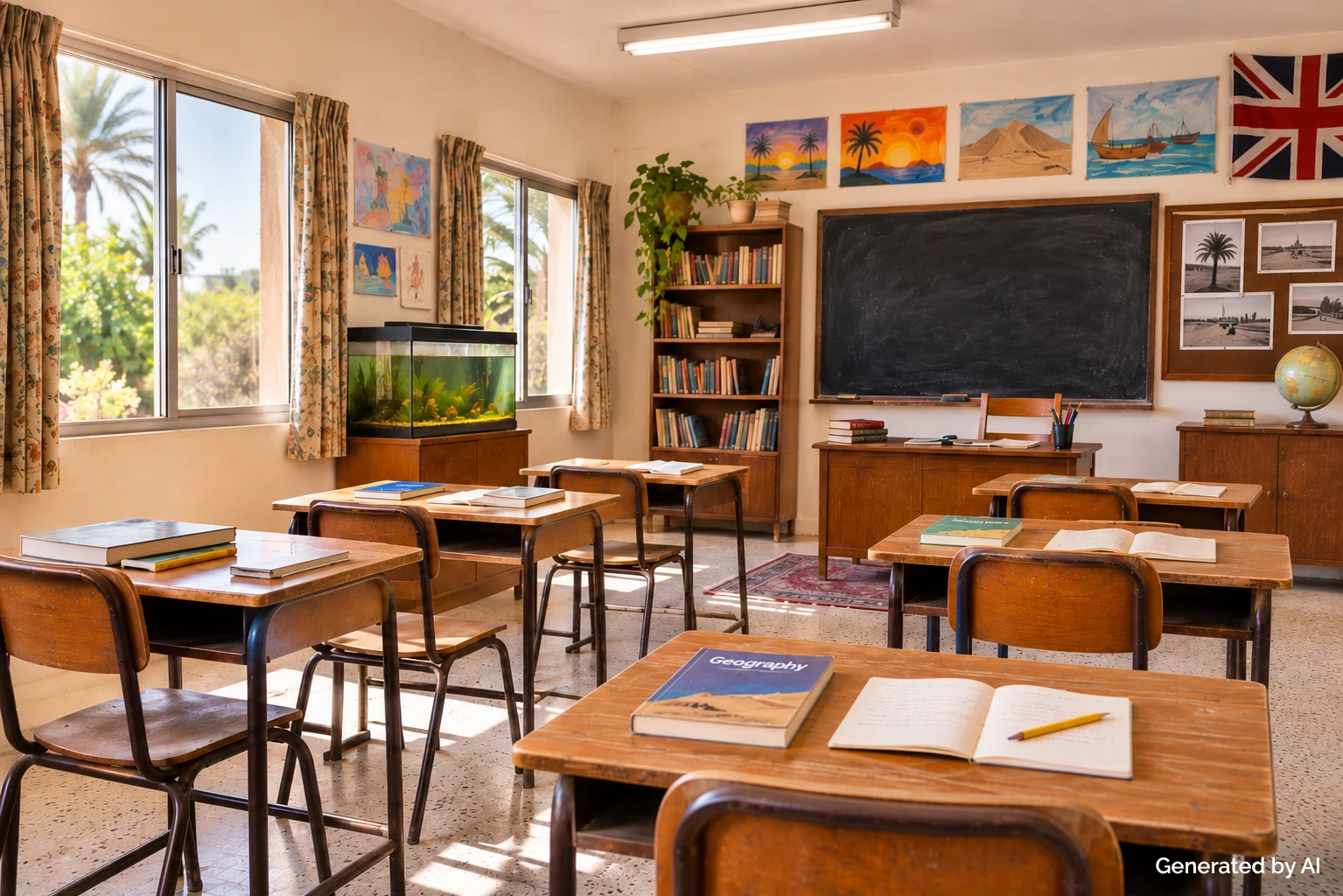
While primary schools like the Dubai English Speaking School (DESS) had operated since the 1960s, there was a severe shortage of secondary educational institutions offering recognised international qualifications. Expat families reaching the end of their children's primary years faced a difficult dilemma: relocate back to their home country or send their teenage children to boarding schools overseas.
To resolve this and build a stable long-term workforce, local leadership recognised that Dubai needed a British-style secondary education for older children. After permission from His Highness Sheikh Rashid Bin Saeed Al Maktoum, the Ruler of Dubai from 1958 until 1990, Dubai College was established in May 1978 to provide exactly that – secondary style British education in Dubai. Its founder was Tim Charlton, who with his wife found support and sponsorship from AJ Foulger, the first College Bursar. After this, Charlton became known to several local businessmen. Meetings with banks, architects and interested parents followed. He was then handed a plan of Plot B141 signed by his Highness Sheikh Rashid Bin Said Al Maktoum to build a school.
The physical classroom layout as suggested in the picture highlights the transition from early primary setups to a more specialised secondary education. Typical wall displays of the time capture the dual cultural identity of foreign schools in Dubai. The classroom's interior details reflect the domestic, community-focused character of early international schools in the UAE. Before purpose-built modern mega-campuses were completed, schools like Dubai College began inside converted residential villas in neighbourhoods like Jumeirah and Safa. The presence of home-like touches such as curtained glass windows looking out over lush palm foliage, an aquarium with live fish, potted houseplants and a decorative rug all illustrate how schools became a welcoming and stable part of life for families in the UAE, especially given that pupils were living so far away from home.
Following the unification of the United Arab Emirates in 1971, Sheikh Zayed bin Sultan Al Nahyan wanted to create a universal state-funded public education system that everyone could be a part of. The Ministry of Education was formed to replace the informal spaces and converted villas of the pre-federation era with a network of public schools.
Across the 1970s and 1980s, the UAE invested heavily in civil infrastructure. Backed by growing national oil revenues, state planners designed standardised, high-capacity schools that could serve thousands of families across all Emirates.
Al Qasimiyah School was originally commissioned by the Ministry of Education as a boys' primary school. The photo in this blog suggests what the building would've looked like based on classrooms at the time. The building was designed with climate in mind, with classrooms focused around inner courtyards, daylight and natural ventilation. Walking neighbourhoods were allocated between girls and boys, and schools were a real focal point of community life. The school is a two storey building with 24 classrooms, a library, five labs and a theatre spanning two floors.
Al Qasimiyah school is currently the Sharjah Architecture Triennial headquarters. The building acts as a venue for public exchange and architectural conversations because of its historical legacy as an educational hub. The authorities chose to reuse the venue rather than demolish it in order to preserve its regional heritage and cultural significance.
The school has been renovated and adapted for its new civic role while carefully protecting its original architectural integrity. The building's twenty-four original classrooms (characterised by their structural precast concrete flat vaults) have been converted into exhibition halls, workshop spaces and offices. To better accommodate large-scale displays, adjacent classrooms were merged into wider gallery wings.
By the mid-noughties, Dubai was already laying the groundwork for digital transformation in the classroom. As the emirate rapidly positioned itself as a regional hub for technology and media, educational leaders recognised that preparing students for the 21st-century workforce required moving beyond traditional paper-based instruction. School systems in the UK and many other countries were still considering whether computer labs were needed, while Dubai began putting computers at the front and centre of learning. Technology wasn't just seen as a separate weekly subject taught in an isolated lab, but as the primary medium through which core subjects were delivered.
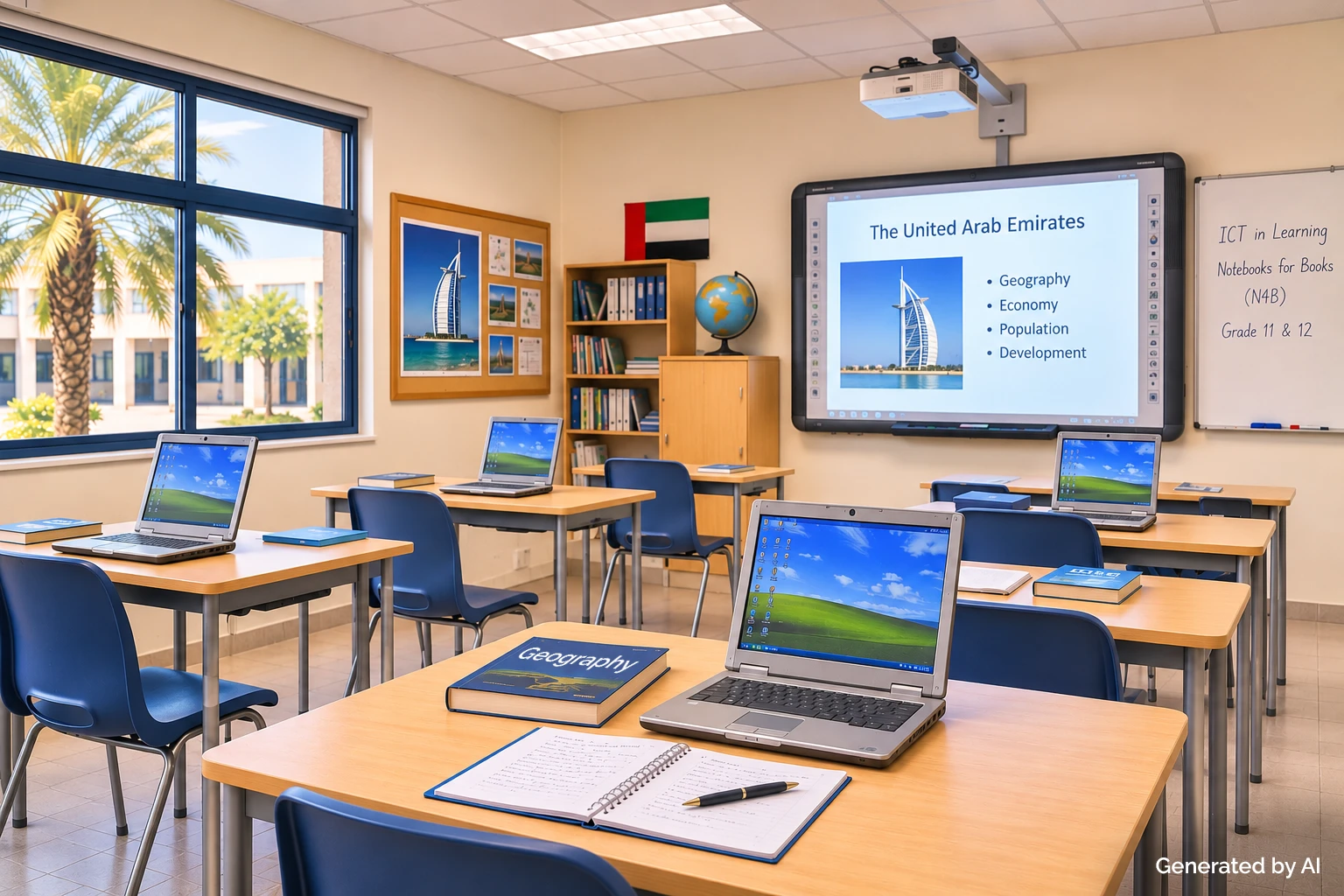
Al Mawakeb School, Dubai is an example of a school that put technology at the front and centre of its educational policy in this period. It changed its classes to allow the use of notebook computers to replace traditional books. Every grade 11 and 12 student had a notebook computer with relevant information based on their curriculum and learning level. This 'Notebooks for Books' initiative earned The Shaikh Hamdan bin Rashid Al Makthoum Award for Distinguished Academic Excellence in the Best Applied Project category for 2004-2005.
The success of Al Mawakeb School’s initiative highlighted that the UAE’s smart education drive was well underway years before national initiatives like the Mohammed Bin Rashid Smart Learning Programme were formalised in the 2010s. This created the foundations for the paperless, interactive and tech-first campuses that define UAE education today.
As the image suggests, classrooms of the time would feature thick and heavy (by modern standards) silver laptops, marking the historic transition from paper exercise books to personal digital workstations. Traditional blackboards were transformed into interactive whiteboards and ceiling projectors mounted at the front of the room, enabling digital presentations and a more interactive way of teaching.
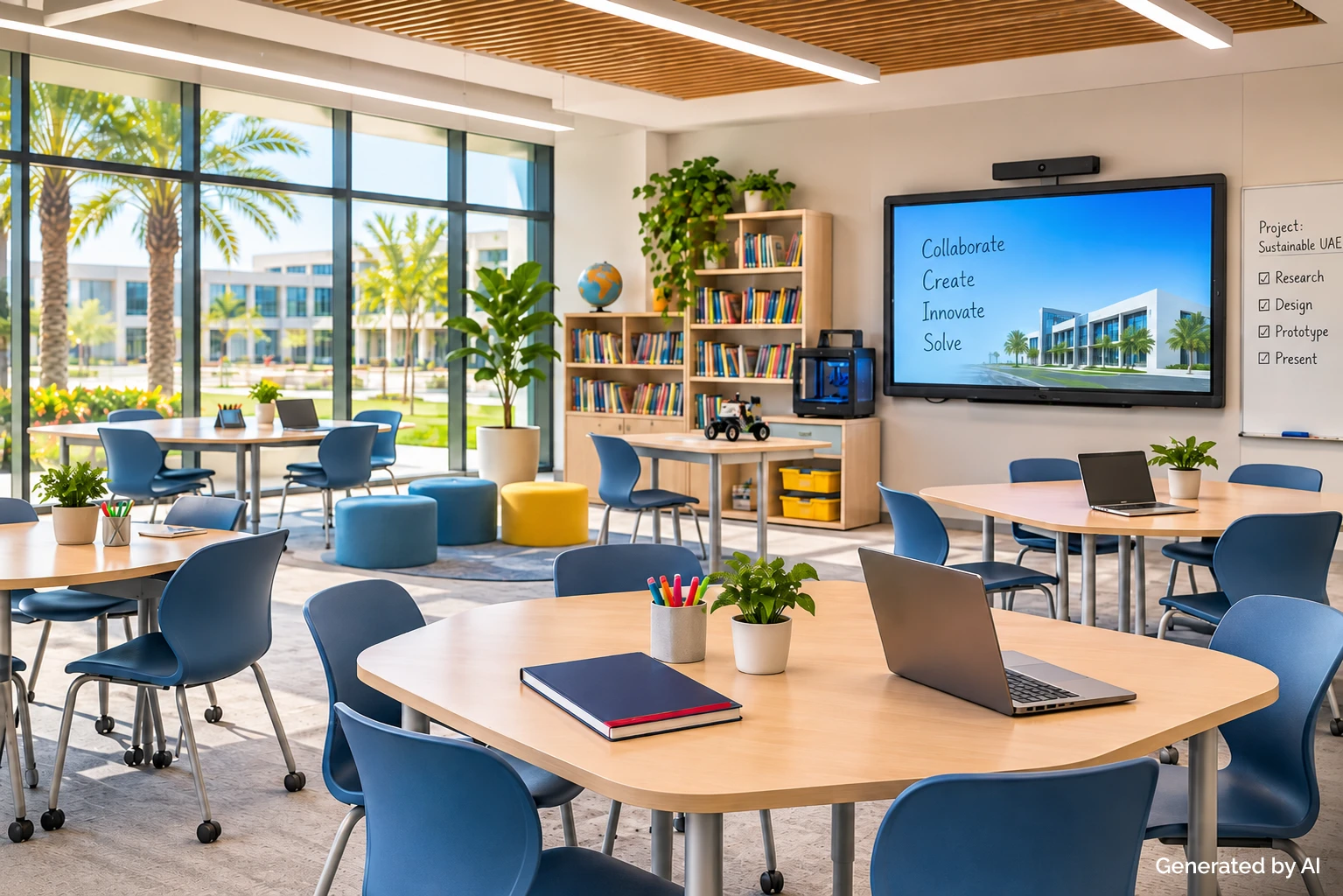
The American Community School of Abu Dhabi is an example of how modern education in continuing to evolve and change the role of tech within schools across the UAE. Although its original campus facilities were considered of good quality and well resourced, ACS relocated in 2024 to a new purpose-built site on Saadiyat Island. This was mainly to improve its technology facilities for students. Designed by an award-winning international architectural firm, the campus is seen as a leading school with world-class technology facilities focused on robotics, artificial intelligence, virtual reality (AI), machine learning, a science wing, a 650-seat theatre and an expansive art gallery. There's also an Arabic Institute of Excellence to encourage the teaching of Arabic and teacher training opportunities.
The modern classroom is designed around flexibility in learning. Instead of static rows facing a front desk, the room features pod-style tables paired with ergonomic chairs on castors, which allows students to seamlessly switch between working in small-groups and independent project work. Floor-to-ceiling glass walls flood the interior with natural daylight, physically connecting the indoor learning space with the outside to focus on wellbeing. Sleek, lightweight laptops and tablets sit directly alongside physical notebooks, sketch pads and creative tools, showing how modern classrooms embrace technology daily while still valuing creativity.
The UAE’s educational landscape has undergone remarkable growth throughout the decades. While these snapshots capture particular milestones in that timeline, they represent just a fraction of the country's ongoing cultural and civil dedication to learning. As the nation continues to grow, its educational environments will continuously evolve as new technologies come and go.
Teaching Abroad Direct helps UK teachers secure teaching positions in international schools across the UAE.
Visit www.teachingabroaddirect.co.uk to learn more about English teaching opportunities overseas and for teaching jobs in Dubai and teaching jobs in Abu Dhabi.
Teaching Abroad Direct regularly speaks with British teachers currently working overseas.
Journalists interested in speaking with teachers currently working in Dubai and Abu Dhabi can contact us via [email protected]


